FAQ
Short answers to the questions people ask in their first week, each with the place to go.
- Who it is for
- New to Bellwether
- Reading time
- 5 min read
- Updated
Short answers, each with the to open. If yours is not here, search the help center or ask , which answers from these same articles.
Does Bellwether move money?
No. It places orders in a brokerage account you own; deposits, withdrawals and statements happen at the broker, never here. Accounts shows the account, read-only.
Can it switch itself to real money?
No. Your book runs on a and the PAPER pill in the top bar says so. Going live is a deployment change made by the operator after the checklist on Paper → live readiness passes; no button in this build does it, for anyone, and a live flag that does not match the deployment halts trading instead of trading live. See paper vs live.
What happens if I ignore a card?
It expires unsent at the end of its , and the PM (shown as on screen) is told you did not decide in time so it can re-propose at a fresh price if the idea still holds. Nothing is placed without a yes; see thesis windows.
Can I place a trade myself?
Not yet. There is no order form, for anyone; you approve, reject, steer, or everything in an emergency. Your own orders are planned: place a trade yourself.
Why is the Inbox empty?
Because nothing needs you: either the PM proposed nothing, or every order was at or under your and cleared the checks on its own (see Decided today in the Inbox). The threshold is the dial on Strategy › Profile › Autonomy; no trades today lists the other reasons.
What does Halt do?
It makes the book reduce-only within about 5 seconds, from any screen, with no code (owners and operators only): no new buys go out, buy orders still resting at the broker are cancelled, and queued or approved buys are blocked. Open positions are kept, and sells still go (a trim or close the PM proposed, a sell card you approve, and the 's own stop and target exits), so a never traps you in a falling position. Nothing is sold because of the halt; selling everything is Flatten, which the Executor carries out within seconds of your request. Resume lives in the halt banner and on Risk and asks for your . Kill switch covers both.
Is my data shared with other books?
No. Every book is its own tenant; every query is scoped to it and a cross-book action is blocked and alerted. Only people you invite or give read-only access under People & access see it.
Can I use it from my phone?
Yes. The console is a website with a phone layout, and a card can be approved from it. Turn on phone notifications per device under Settings › Notifications (on an iPhone, add Bellwether to your Home Screen first); the approval email reaches you as well when the deployment is set up to send mail rather than keep it in the outbox.
What does it cost per day?
Model usage: a few dollars on a normal day, capped by the per-day token budget, a deployment setting that defaults to $25 per book. The Model spend tile on Overview shows today's spend against it; once it is spent, sessions refuse to start until midnight CT. Review shows each day's spend next to its result, net of AI cost.
Why does it ask for my code again?
Dangerous actions (Resume, Flatten, loosening a limit or , raising , a , connecting broker keys, inviting a user) want a code entered in the last 30 minutes, checked on the server, however recently you signed in; a few critical ones (autonomy to Full, inviting another owner, re-issuing a user's setup link, disabling or re-enabling a user, resetting your own , API tokens, anything on Admin) want one from the last 5 minutes. Halting never asks. See account security.
Can the PM trade a stock that is not on the Watchlist?
Yes. The Watchlist is attention, not a fence; any US exchange-listed stock, ADR or ETF can be proposed, and the Executor screens each buy for price, history, liquidity, spread and your on Risk › Tradable universe.
Steering note or hard constraint?
A is guidance the PM must and may disagree with, in writing. A hard constraint is enforced by the Executor: a buy that breaks it is rejected before the run. Both are written on Strategy › Guidance; a hard constraint asks for your code (hard constraints).
Does Consult see my sessions? Does the PM see Consult?
Consult reads the same and recent decisions the PM does, so it can explain one. The PM never sees your Consult chats; it only sees what you confirm from them: a steering note, a watch level, or a question put to its next run. Confirming a card applies it in the same step and writes an audit line (see Consult).
How do I undo a setting change?
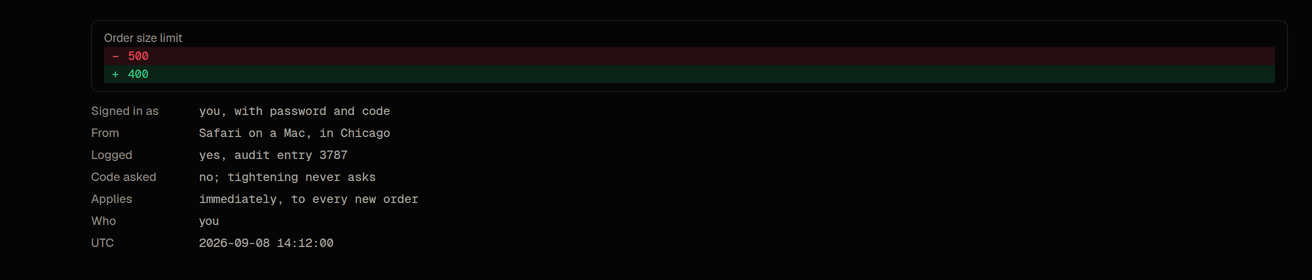
There is no undo button. Activity › Config changes shows every change with its before and after and who made it; set the value back on the screen that owns it. Tightening is one click, loosening asks for a code.
How do I get help?
This help center: Help & docs in your account menu, Help, ⌘K, or the ? beside any screen's title (it opens the article for that screen in a side panel). Ask Consult where something is: its help_search, help_open and where_is tools read these articles and cite them. For a problem, press the flag in the top bar (on a phone, More › Report); the screen you were on is attached and what you write is read the next morning.
What is the faint orange glow at the edges of the screen?
Atmosphere, nothing more: a distant-fire glow in the corners and a little haze that drifts, meant to be noticed on the second look. It never sits behind tables or the agent transcript, it does not react to anything the desk does, and it switches itself off if your system asks for reduced motion. Turn it up, down or off under Settings › Display › Ambient effects; the choice is remembered for your login.