Approve or reject an order
What Approve actually sends, what Reject tells the PM, what happens if you wait, and how it works on a phone.
- Who it is for
- Owners & operators
- Reading time
- 5 min read
- Updated
Approving lets one go to the broker, and only after the has re-priced and re-checked it. Rejecting drops the order and hands your reason back to the PM (shown as on ). Doing nothing is always safe.
What Approve does
You are approving the , not the price frozen when the PM wrote it; on a desktop the button in the Inbox says "Approve at current price (≤ cap X)" for a buy and "(≥ cap X)" for a sell. To approve:
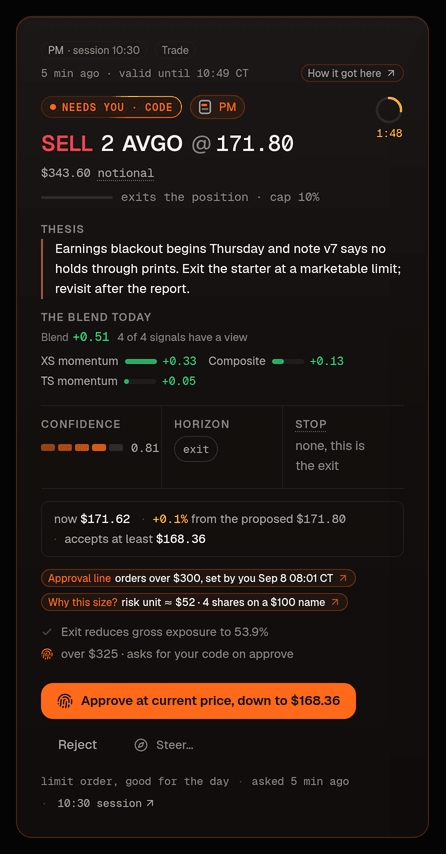
- Read the thesis and the live price line on the card in the Inbox.
- Press Approve at current price. The approval is recorded and audited, the card shows Sending to executor, then moves to Decided today as "approved · queued for the executor".
What happens next is the Executor's, on its next loop (within 5 seconds):
- It fetches a fresh quote and moves the working limit to the current price, bounded by the cap: the 's own cap price, or the re-quote drift allowance of 2% past the working limit, whichever is tighter. A buy's limit never goes above the cap; a sell's never goes below it.
- It runs all again on that price with live data (a quote older than 30 seconds fails check 7). Approval never skips a check.
- If everything passes, one limit, day order goes to the broker. It rests for 90 minutes from submission or the rest of its , whichever is longer, and is cancelled if still open after that; as a day order it also ends at the close.
- If the price is already beyond the cap, nothing is placed: no resting order at the cap, no chasing. The row in Decided today reads Rejected · you with a note that you approved but the price had moved past your cap, you get a "Not placed … price moved past your cap" mail, and the PM's tells the next session to re-propose at a fresh price if the thesis holds.
- If a check fails on the re-check, the order is rejected with that check's reason and reads .
The drift line on the card tells you which case you are in before you press anything; past the cap, the button itself warns. Approving is a yes to this idea, at a price the checks still allow, not a standing instruction.
What Reject does
- Press Reject on the card in the Inbox. A note field opens.
- Optionally write a short note ("not before earnings", "too big for a first position").
- Press Reject SYMBOL. The order is dropped, nothing is sent, and the decision and note are audited.
The note is saved with the decision and goes back to the PM on its next state card and through get_prior_decisions. A rejection with a reason is one of the most useful things you can give it.
If you ignore it
The card expires at the end of its thesis window, unsent; doing nothing never places a trade. It shows under Decided today as Expired, the PM's state card lists it as expired unreviewed for the next 24 hours so the next session does not read silence as a no, and the day report counts expired cards so you can tell whether your approval threshold· Strategy › Profile › Autonomy is too low.
Cards that need you are emailed to the owner ("Approve? BUY 2 NVDA @ 185.40 ($370) · 14:30"); with no outbound mailer configured the message only lands in the console's outbox. There is no switch for it. A phone notification for a waiting card can be switched on per device under Settings › Notifications; it opens the Inbox and cannot approve anything itself. See notifications.
NoteA notification only opens the Inbox; nothing is ever approved from one.
During a halt
While trading is from the top bar or Risk, or by the Executor itself on a loss limit or a broker problem, the book is reduce-only. Waiting cards keep their clocks and can still expire. A buy you approve during a halt is marked Blocked on the Executor's next loop, not rejected: the idea was fine, trading was stopped. It shows in Decided today under the Rejected · policy pill with the halt reason as its note, and it stays blocked after you resume; the PM proposes afresh in its next session. A buy you approved just before the halt that was already resting at the broker is cancelled there and reads Expired with a halt_cancel: note. A sell card (a trim or a close over your threshold) is different: approving it during a halt still sends it, re-quoted and re-checked like any approval, because taking risk off is exactly what a halt allows. The Executor's own stop and target exits never appear as cards at all; they are pre-authorized by the entry you approved and keep working through a halt.
On the phone
Below tablet width (768 px) the buttons become a full-width row at the bottom of the card, and the card takes a swipe:
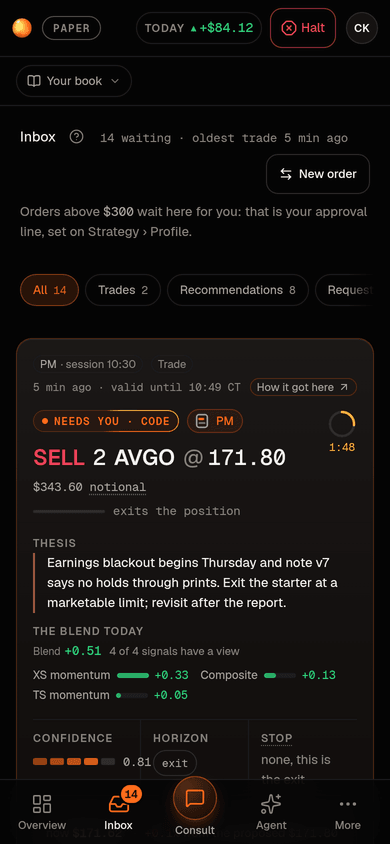
- Swipe right arms Approve: the card shows a Confirm approve / Cancel step with the order line and . The gesture never approves by itself.
- Swipe left opens the note field and a crimson Reject button.
- A short drag stays a scroll; the release must clear about a third of the card (112 px at most) or it snaps back. A hint under the buttons reads "swipe → approve · ← reject".
A on large approvals (Needs you · code, then the step before the approval goes through) is planned, not in the console yet; no approval asks for a code on this build.
Who can approve
Owners and operators of the book, managed under People & access. Reviewers, viewers and anyone you have shared the book with see the same cards with Approve and Reject disabled. Every decision writes one audit line: who decided, the note and, for an approval, the cap the re-quote must honour and the window end. The same re-check, caps and halt apply on paper and on live.