Briefs and calls
The 07:45 and 12:00 briefs: what is in them, where every source comes from, how a call is scored, and how the 08:00 session uses the brief.
- Who it is for
- Everyone on the book
- Reading time
- 4 min read
- Updated
Twice on every trading day the writes a short, cited brief about your book: at 07:45 CT, before the PM (shown as on ) starts the 08:00 premarket session, and at 12:00 CT on what changed since the open. On a half day the midday brief is dropped. Briefs are kept indefinitely.
Read them on Research: the Briefs panel lists today's and earlier briefs with time, model, cost, tickers and call score, and searches 90 days by symbol or word. Opening one swaps the feed for the full text.
What a brief contains
The same headings in the same order, every time:
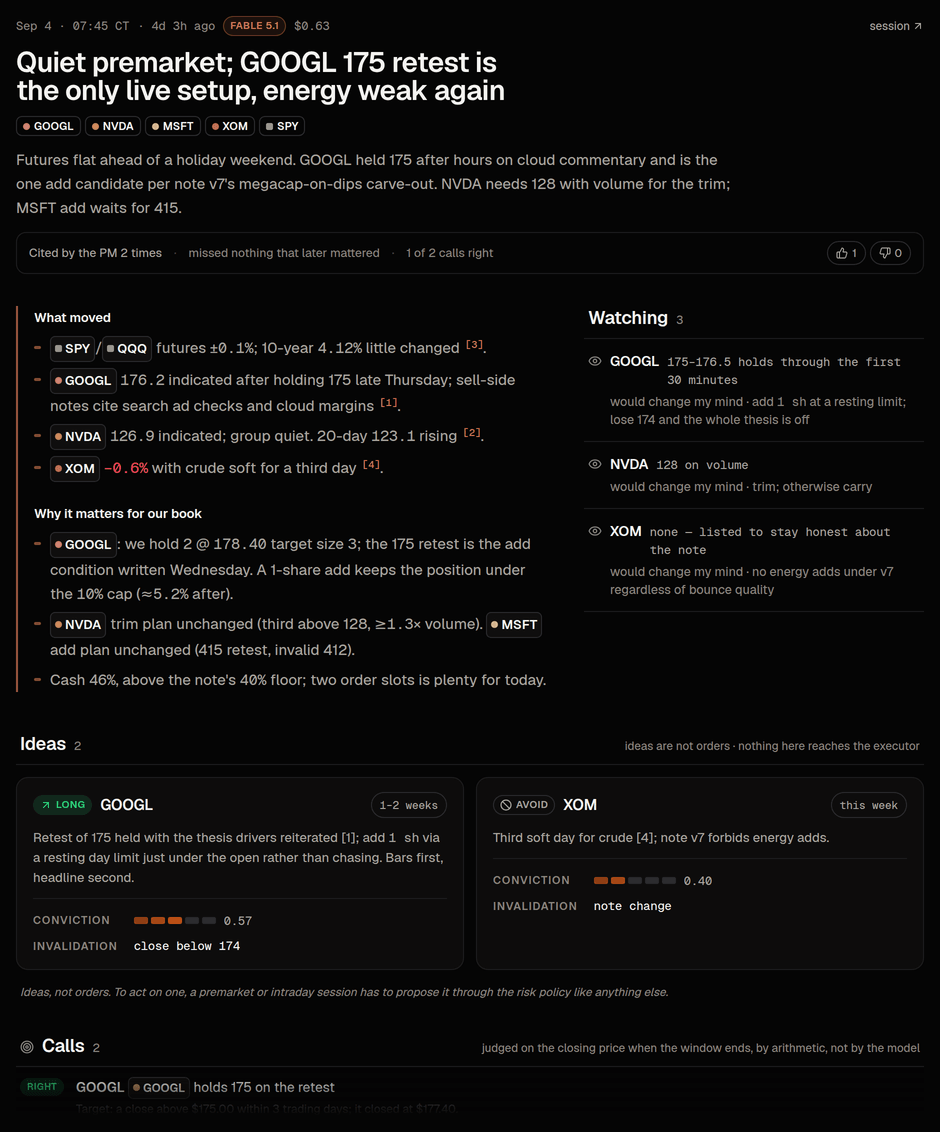
- What moved. Three to six bullets: symbol, the move, one line of reason with a numbered source. Index context (SPY, QQQ) comes first when it explains the tape.
- Why it matters for our book. Each point is tied to a holding, an open , cash, an or a limit; the next macro release is always named. When nothing changes, the brief says so.
- Watching. One symbol, one numeric trigger, and what it would unlock.
- Ideas. Zero or more, each with a direction (Long, Trim, Exit, Avoid, Watch), a conviction meter, a horizon, the rationale and an explicit , sized in shares and dollars against today's caps. "No ideas today" is a normal outcome.
- Calls. Up to eight checkable statements the Researcher is willing to be scored on.
- Sources. A numbered list.
Ideas are context, never orders. To act on one, a later premarket or intraday session has to propose it through the like anything else.
Where the sources come from
The Researcher has no browser and no network. Headlines reach it only through the hub's own tools, get_research_feed (the same feed you see) and get_news, as headlines and short summaries, never article bodies, always marked as untrusted third-party text. A brief may cite only URLs those tools returned in that session. Any other link is dropped before the brief is stored and a warning alert is written, so a headline cannot smuggle a link into your Sources list. Price and volume evidence and prior decisions outrank headlines; news is context, not a . Your open pins and the notes you wrote on them reach the same prompt from your book's own pin list, labelled as your requests and as data rather than instructions; they are never part of the shared feed, so no other book's brief can quote them (pins and the feed).
In the brief view, Sources shows publisher, host and time; "From the hub" lists the feed items that made it in, and those cards carry a "cited in 07:45 brief" badge.
Calls and how they are scored
A call is one line: symbol, statement, horizon in trading days (at most 60), and a check (above or below a level, inside a range, or an event). Example: NVDA above 130 within 5 trading days. A call must rest on at least one feed, news or filings item the session actually read, or it is dropped before the brief is stored and a warning alert is written.
Scoring is mechanical, with no model grading. A call is due at the close of its last trading day; once a day the research worker's housekeeping pass takes the daily close on that date and marks the call hit or miss: above means the close was higher than the level, below means lower, range means inside it. Event calls, and calls with no close available, stay undetermined for you to judge.
Where the score shows: each brief row reads "calls 3/5 hit" (hits over scored calls) or "3 open" while nothing is scored yet; the brief header's relevance line repeats it beside "used by Analyst: N refs" ( within 24 hours that cited the brief) and "misses" (held or names the PM still had to pull news or filings on in the 6 hours after the brief); and the on Review lists hit, miss and open counts per brief. The Useful and Not useful buttons on that line log your verdict to the feedback log. There is no combined hit rate across briefs yet; the win rate on Performance is the book's own closed trades, not the Researcher's calls.
How the brief feeds the 08:00 session
The premarket session reads the latest brief from its (id, age and up to eight headline bullets) as its news baseline, and does not re-read raw news unless the brief is stale (older than 6 hours or from a prior trading day) or a held name has breaking news. Before proposing on a symbol it calls search_briefs for open calls on that name, and it tags any proposal that leaned on a brief so utilization can be counted.
Every brief is a session of its own; the "session" link in the brief header opens it on Agent.