Thesis windows
When a premarket or intraday idea becomes orderable, when it expires, and why the card gives you hours instead of a ten-minute fuse.
- Who it is for
- Everyone on the book
- Reading time
- 4 min read
- Updated
Every carries the stretch of time the PM (shown as on ) thinks its idea stays valid: its . It decides two things: the earliest moment the may act on the order, and the moment the card expires unsent. The clock on every card in the Inbox shows how much is left.
The order window
An order is never sent in the first or last minutes of the session. NO_TRADE_MINUTES (default 15, on Risk › Limits) blocks both ends, so on a regular day the first orderable instant is 08:45 CT and the last is 14:45 CT. The PM stamps each proposal with an order window that fits inside that:
| Idea written | Orderable from | |
|---|---|---|
| Premarket session | the open plus the no-trade minutes: 08:45 CT | 30 minutes before the close: 14:30 CT, and at least 90 minutes after it became orderable |
| Intraday, ad-hoc or reaction session | now | 15 minutes before the close: 14:45 CT, which is also the last orderable instant, however late in the day it was written |
| The 14:48 CT close-confirmation pass (11:48 on a half day) | the next session's open plus the no-trade minutes: 08:45 CT tomorrow | that session's 14:30 CT, stamped exactly as tomorrow's premarket session would stamp it |
Both ends are capped at the last orderable instant of their session, so a window never runs into the closing tail, and only the close-confirmation pass writes for a later session (today's window has already shut when it runs at 14:48; see the trading day); on an early-close day the same rules count back from the earlier close. The PM may shorten its own window when the idea is more perishable, down to 5 minutes, never lengthen it; an out-of-range request is clamped and logged. The deployment can move the cutoffs earlier, never later, and there is no console control for them.
A premarket idea therefore waits, and so does an order parked by the 14:48 pass: the Executor treats it as deferred, not rejected, until 08:45 CT (held out of the actionable list and counted, never starving the queue) and prices it at the window from its peg and cap, then runs every check on live numbers. If trading is while it waits, it is blocked at once; a halt does not wait for a window. A parked order above your line is a card you can reject all evening. The PM can also take one back before it is sent: a cancel aimed at an order that has not reached the broker (parked, queued, or waiting for you) withdraws it: the proposal closes as rejected with a "withdrawn by analyst" note and nothing is sent. That is how the 08:00 premarket session drops a parked order the overnight news invalidated. A modify on such an order is refused as not live; the PM withdraws and re-proposes instead.
While the card is waiting for you
Once an order crosses your it becomes a card, and it stays approvable for the whole thesis window. There is no separate approval countdown: the "valid until" time on the card is the window end, and an approval at 14:29 CT on a premarket card is as good as one at 09:00 CT.
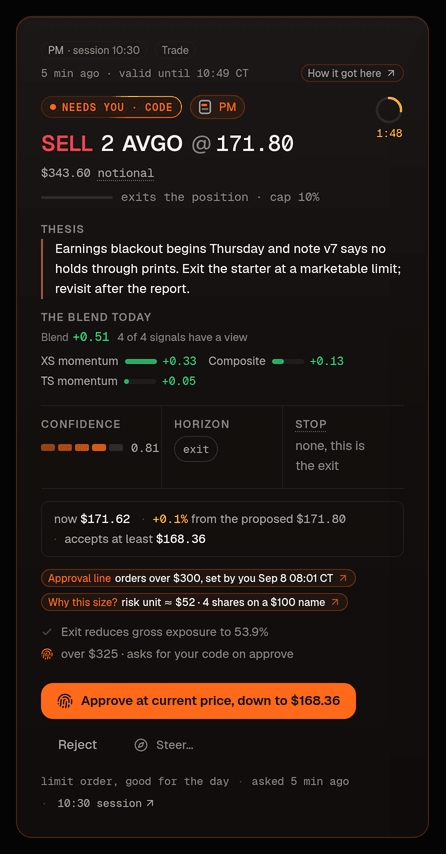
Becoming a card never shortens the window, and no approval outlives it: an approval after "valid until" is refused. The order that results from a yes gets its own resting time from the moment it is submitted, at least 90 minutes or the rest of the window, whichever is longer (see approve or reject).
Why hours, not a short fuse
You may be looking at a card hours after the PM wrote it. A short fuse would push you to decide before you have read the , and it would not make the order safer: the price on the card is stale the moment it is drawn. The safety comes from what happens when you press Approve: the Executor fetches a fresh quote, re-anchors the limit inside the cap, and runs every risk check again on live numbers. Past the cap, nothing is placed.
So the clock on the card is information, not pressure. The ring turns amber only inside the last two minutes, and the cards in the Inbox are ordered so the one expiring first is on top.
What "expired" means for the PM
When the window passes with no decision, the Executor marks the proposal expired and unreviewed on its next loop. Nothing was sent and nothing is lost. The PM is told two ways: an info alert, and a line on its ("operator didn't review in time; re-propose at a fresh price if the thesis holds") that stays for 24 hours, so the next session does not read your silence as a rejection. The same line covers an approval the price had run past. The PM may re-propose at a fresh price or drop the idea; its reasoning either way is on Agent.