Reading a card
Every field on an approval card, what "Needs you · code" means, and what the Decided today list is telling you.
- Who it is for
- Everyone on the book
- Reading time
- 7 min read
- Updated
An approval card is the PM (shown as on ) asking permission for one order. Cards live in the Inbox and open as a drawer from any screen. Every trade card has the same shape: what, why, what the checks said, how long the idea stays valid. The same screen is the one Inbox for everything else that wants a decision (desk suggestions, requests and high-severity findings), and every item starts with the same small row saying who put it there; the provenance section below covers each kind.
What is on a card
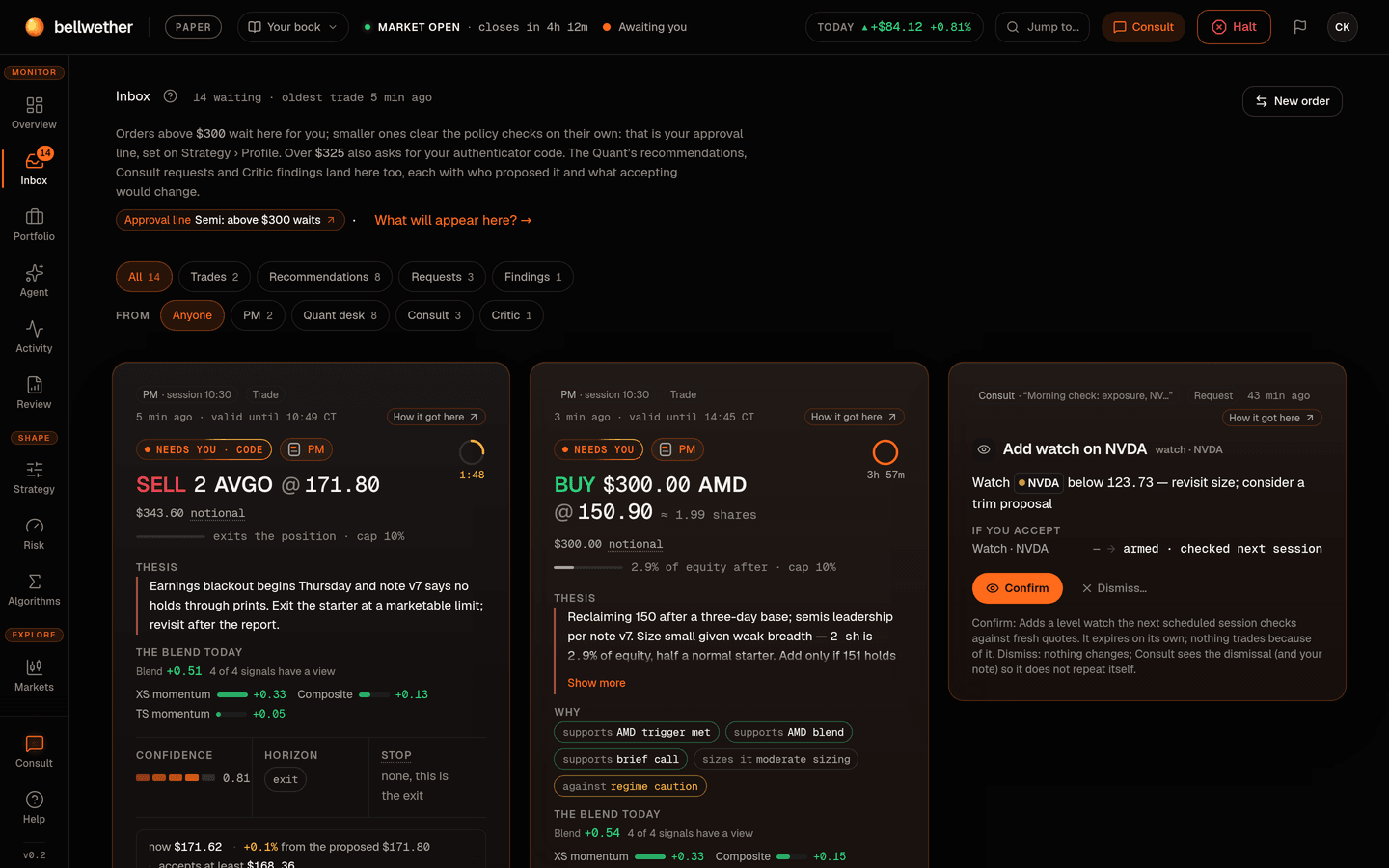
- The order: buy or sell, shares, symbol and limit price in one line. Under it: the size in dollars (the ) and that size as a share of your account, drawn against the 10% position cap. A sell that leaves nothing behind reads "exits the position". A pegged order also shows "pegged · proposed 185.40", the price the PM wrote before the resolved the working limit.
- The : the PM's reason, in its own words. Read this first; you are approving the idea, not a frozen price.
- Confidence and horizon: how sure it is, 0 to 1 on a five-bar meter, and how long it expects to hold.
- or stop: on a buy, the price that would prove the idea wrong; on a sell, the stop it is acting on ("none · exit" for a plain close-out).
- The live price line shows the current quote, its drift from the price, and the cap: the most a buy will pay or the least a sell will accept when you approve. After a drift the line turns amber and says what approving now would do; past the cap it turns red and says nothing would be placed.
- The checks: the 's notes. A card that reaches you has already passed every check, so the usual line is "18 checks passed · needs your approval". The per-check list, numbered by check (1–17 and 20), is on Agent › proposal checks.
- The clock: a ring that empties as the runs out, with the time left ("3h 12m", a live mm:ss countdown inside the last hour, amber in the last two minutes). Hover it for " 14:30 CT". See thesis windows.
- The footer: "limit · day", the only order type the Executor sends; when it was asked; a link to the session that wrote it on Agent; and Steer…, which opens Strategy › Guidance prefilled with the symbol (desktop only).
The card carries no votes and no Critic note. live on Algorithms; the Critic's findings sit on the session detail on Agent, and its pre-trade pass runs before the card reaches you (a proposal that opens a position or is $250 or more waits up to 90 seconds for it, then goes on without it).
Where this card came from (provenance)
Every item in the Inbox opens with one grey row: a proposer chip (who put it here), a kind chip (Trade, Desk suggestion, Request or Finding), when it was asked ("12m ago"), valid until HH:MM CT when the item has a clock, and on the right How it got here →, the link to the trail that produced it. The two filter rows above the cards ("Trades / Desk suggestions / Requests / Findings" and "from PM / Quant desk / Consult / Critic / You / Executor") filter on exactly those two chips. Under the body, items other than trades add an If you accept block of before → after rows and one muted line spelling out what each button does, so a Dismiss is never a surprise.
What each kind shows today:
| Kind | Proposer chip | How it got here → | If you accept / the buttons |
|---|---|---|---|
| Trade (an order over your line) | PM, or Executor · stop / · target on a protective exit the Executor raised itself | The session that wrote it, on Agent (, transcript, tool calls); an Executor exit with no session links to the symbol's rows on Activity | Approve re-quotes, re-runs all risk checks and sends; Reject (with a note) tells the PM why; doing nothing lets it expire unsent at "valid until" and the PM is told to re-propose if the thesis holds. Details in approve or reject. |
| Desk suggestion from Consult (a or change) | Consult with the thread title in quotes, or You when the intent was one you stated in the thread | The Consult thread it came from, on Consult | The setting, current → proposed (amber, with a passkey mark, when it is a loosening). Confirm opens the same dialog the thread uses, with the same bounds, typed word and as the settings screen. Dismiss… takes an optional note; nothing changes, and Consult sees the dismissal and the note so it does not raise it again in that thread. |
| Desk suggestion from the Quant desk (reweight the algorithm ) | Quant desk · the method · "deterministic" | The suggested-weighting card on Algorithms, with its Why? panel | One row per algorithm, weight now → suggested. Apply weights is one audited write of the blend (modes, ranks and every risk limit untouched). Not now only hides it in this browser until the advisor computes a new suggestion; Algorithms keeps showing it. |
| Request from Consult (a or , a or level, a brief, an Analyst run) | Consult or You, as above | The Consult thread | What it becomes: "Steering note → active · next session" (a hard constraint is marked Executor-enforced and needs the code), "Watch · NVDA → armed · checked next session", "Researcher brief / Analyst run → queued now" with its cost estimate, or "→ pinned to the next session". Confirm and Dismiss… behave as for a Consult desk suggestion. |
| Finding (an open, high-severity Critic finding) | Critic · "pre-trade pass" or "session review" | The session the finding is about on Agent, or the Critic's own run | No accept: the PM answers findings, not you. Discuss in Consult opens Consult with the finding attached; Make this a steering note turns it into a note the next session must acknowledge; Dismiss records that you saw it and disagree (audited) and the PM is no longer asked to respond; Reopen puts it back. It carries its own valid-until and reads "expired" after it. |
A few limits of this build, stated plainly. The provenance row is on the Inbox screen only: the compact trade cards on the Overview's Needs you list and in the slide-over drawer show the order, thesis and clock but not the row, so open the Inbox for the trail. Consult suggestions and the Quant desk's card show when they were made but no valid-until, because those items do not expire on a clock yet; the desk's rule that every card expires visibly is decided and applies to trades and findings today. And the trade card's footer still repeats "asked … · session" from before the row existed; both links go to the same session.
What "Needs you · code" means
Every order is compared to your , the dollar size above which it waits for you; the Inbox header shows it ("Orders above $200 need you"). Orders at or under it go through on their own and appear under Decided today. The autonomy dial moves it.
A second, higher line over which an approval would also ask for your authenticator code is planned, not in the console yet. When it lands, those cards read Needs you · code and the checks add "code check on approve". On this build every waiting card reads Needs you and Approve never asks for a code.
Decided today
Below the waiting cards: every proposal that left the queue since midnight CT, newest first, with your note or the policy's, what happened after, and a verdict pill.

| Pill | What it means |
|---|---|
| Approved · you / Auto-approved | You said yes, or the order was at or under the threshold; the outcome reads "approved · queued for the executor", "working at broker", "filled" or "partially filled". |
| Rejected · you | You said no; your note is shown. Also used when you approved but the price had moved past the cap: the note says so (approved, unfillable, price moved) and nothing was sent. |
A risk check failed (on the first pass or on the re-check after your approval), a hard constraint or Required algorithm vetoed a buy, or trading was : the note carries the check, the steering:<note_id>:<kind> reason or the halt reason. A halt marks the proposal blocked, not rejected, so the PM knows the idea was fine. | |
| Expired | Nobody decided before "valid until". Nothing was sent; the PM is told to re-propose at a fresh price if the thesis holds. |
If you are a viewer
Reviewers, viewers and anyone the book is shared with see the same cards, clock and Decided today list, with Approve and Reject disabled and a hint on the button ("Owner/operator only", or on a shared book a note that it is read only and this book's own operator acts on it); nothing on a read-only view can place or drop an order. Steer… still opens Strategy › Guidance, but saving a note there needs the owner or an operator too.