Guidance: standing and for now
One list of notes to the analyst. Standing guidance is your house style; guidance until a date or an event is a nudge for now that expires and must be acknowledged. When your words read as a rule the executor can enforce, you choose Enforce or Keep as guidance.
- Who it is for
- Owners & operators
- Reading time
- 5 min read
- Updated
The PM (shown as on ) starts every session with a blank memory and one page of context, the , built from three layers: hard rules the enforces (layer 1: posture, limits, the tradable universe), your in words (this article), and its own memory of positions, and . This article is about the words.
One list, two lifetimes
Strategy › Guidance is one list and one box. Every note you write has a lifetime:
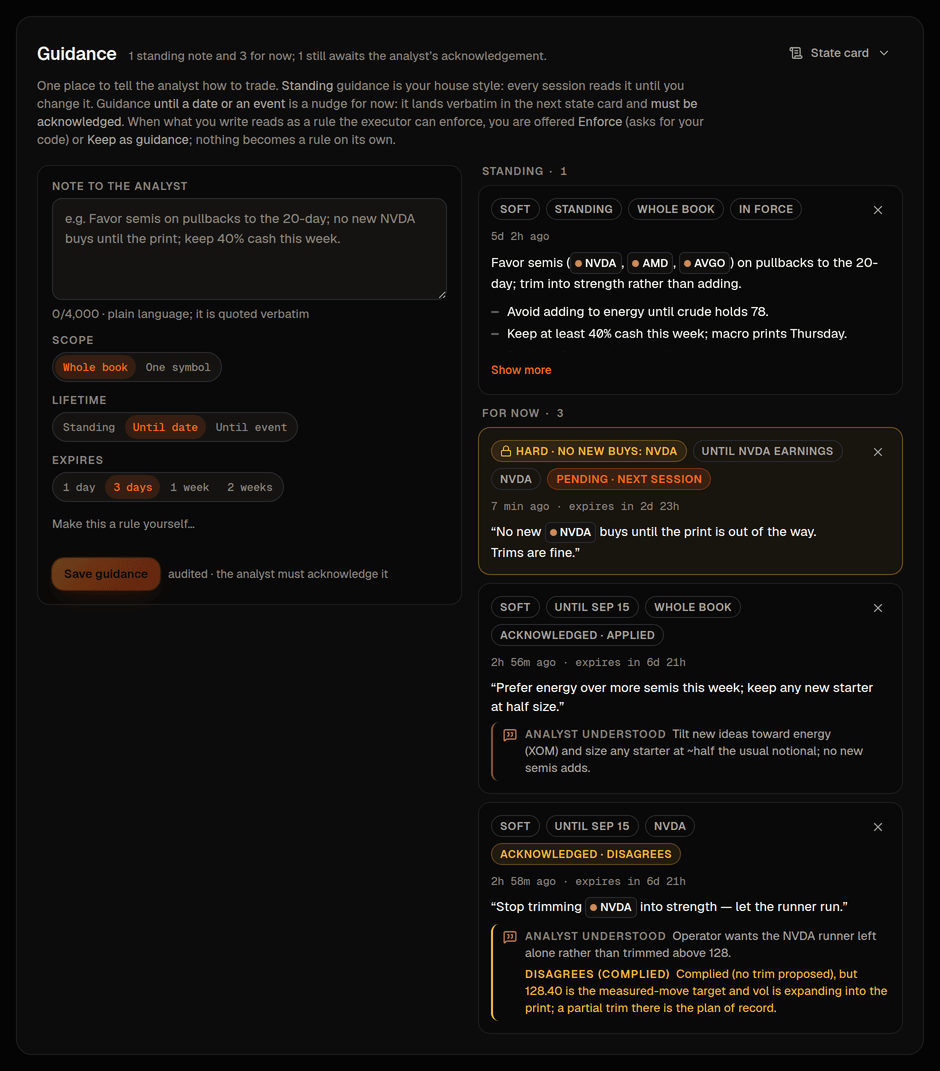
- Standing. Your house style in your own words: "prefer large, boring companies", "no averaging down", "half-Kelly at most". It applies to every session until you change or dismiss it, and it renders first on the state card under Standing guidance. The PM reads it; it does not it note by note (if it cannot follow one today it says so, with a reason). This is what the Playbook used to be; your old Playbook text is now your first standing note.
- Until a date or until an event. A nudge for now: "no new NVDA buys until the print", "keep 40% cash this week". It expires (1 day, 3 days, 1 week or 2 weeks; an event name is for people and still lapses after two weeks) and renders under Guidance for now (acknowledge every one). Every session while it is active must say how it understood it: applied, not applicable, or complied but disagrees (with a reason). You see that trail on the note. This is what Steering used to be.
Notes are about the whole book or one symbol. Up to 4,000 characters of plain language; they are quoted verbatim.
Soft or enforced: decided when you save, never by accident
You do not pick "soft" or "hard" up front. Press Save and the box tells you what your words read as: "This reads as 2 enforceable rules: No new buys in NVDA · Cap at 40% + a standing thesis." Per rule you choose:
- asks for your , then saves the rule as a hard constraint: the Executor rejects any buy that breaks it from its next loop (sells always pass), whatever the PM thinks. The rule keeps the note's lifetime.
- Keep as guidance keeps the words soft: the PM weighs them and must acknowledge them, the Executor does not enforce them.
The rest of what you wrote (the thesis, the reasons) is saved as guidance either way. Nothing becomes a rule without your click, and the audit log records your words, the rules that were suggested and what you chose. The reading is done by fixed text patterns ("no new buys in X", "don't buy X or Y", "keep gross under N%", "keep N% cash") and, on hosts where it is available, by a small fixed classifier that may only answer in that same closed set of rules; anything else it says is discarded. Make this a rule yourself… under the box opens the manual rule builder when you would rather spell the rule out.
To add a note:
- Open Strategy › Guidance and write to the PM in plain language.
- Choose the Scope (Whole book or One symbol) and the Lifetime (Standing, Until date, Until event).
- Press Save guidance. If rules are suggested, answer each with Enforce or Keep as guidance. The note shows at once: standing notes as in force, notes for now as pending · next session until a session acknowledges them.
Notes are created in two more places: Steer… in the menu on any symbol chip opens Guidance pre-filled with that symbol, and Consult can suggest a note as a card you confirm; it uses exactly the same route, bounds and code check as this screen.
Two look-alikes are kept apart on purpose: the lessons the PM writes for itself are weighed separately, and feedback from people you share the book with lands under Review › Feedback for you, never in front of the PM.
Standing guidance
Write how you like to trade, once, and refine it as you learn: what to prefer, what to avoid, how big a starter is, how long you hold, what makes you sell. A standing note has no version history of its own: the audit log keeps every change, and dismissing a note and writing a new one is the way to replace it. If you keep re-writing the same note for now, make it standing.
Guidance for now
For this week, this event or this symbol: it reacts to something happening now, it expires on its own, and it is acknowledged so you can see it landed. An Until event note ("until NVDA earnings", "until the Fed") shows the event on the card; it still lapses after two weeks so nothing steers forever by accident.
The on Strategy › Watchlist is a seed, not a gate. Names you switch on lead each session's reading and appear first on the state card.
weights and modes (Algorithms), cadence and models (Desk › Portfolio Manager › Configure) and the per-role instruction modules on the Configure tab of Agent (instruction modules· Desk › <agent> › Configure › Instruction modules) shape sessions too; each has its own home and Strategy only links to it.
What the Summary tab shows
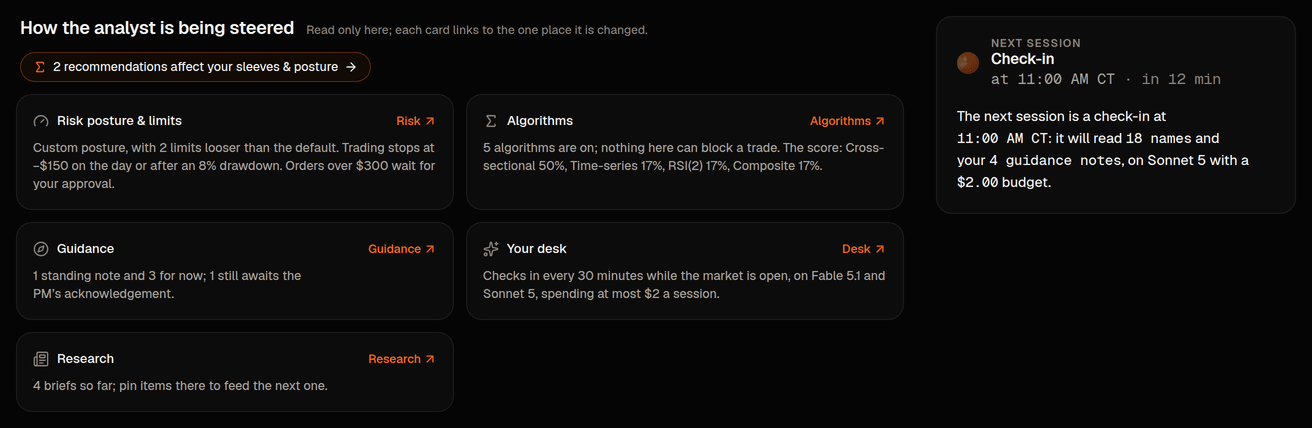
Strategy › Summary is read-only: one card per other way the PM is steered, each with a count and a link to its one editable home ( and limits, Algorithms, Guidance counts, Agent configuration and Research pins), plus the compact next-session preview ("Next session will run at 09:30 CT with: 18 symbols, 4 guidance notes, Sonnet, budget $2.00").
Which lifetime
| Standing when… | Until a date or an event when… |
|---|---|
| The note should hold every day until you change your mind | The note is for this week, this event or this symbol |
| It describes how you like to trade in general | It reacts to something happening now |
| You do not need it acknowledged every session | You want an expiry and an acknowledgement |
Either can be enforced: a standing "never buy TSLA" and a two-week "no new NVDA buys" both become Executor rules when you press Enforce.