The Portfolio screen
Holdings with why each was bought and what would make the desk sell, orders that have not filled, and the last 30 days of closed trades, for the book you are looking at.
- Who it is for
- Everyone on the book
- Reading time
- 6 min read
- Updated
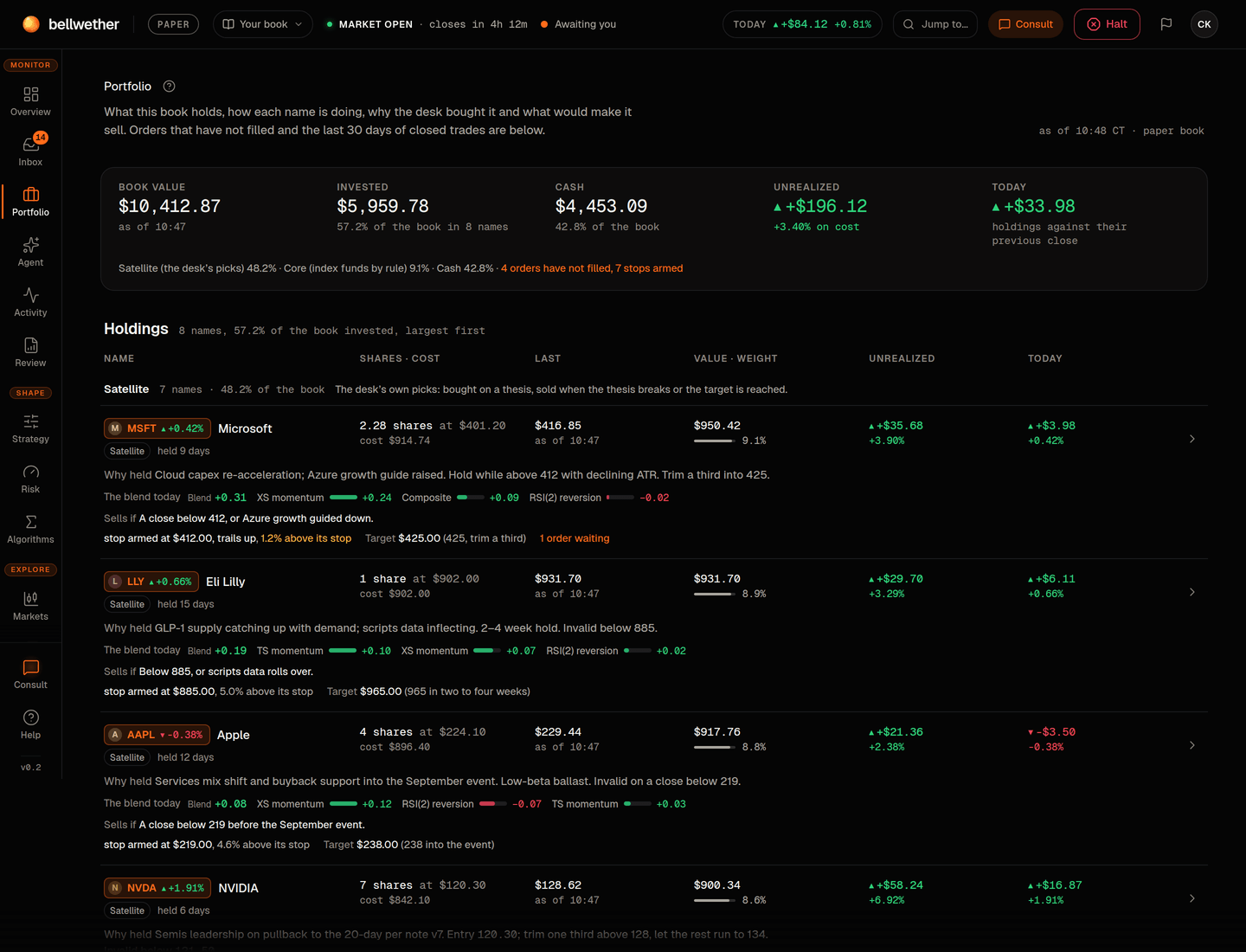
Portfolio is the book's holdings page. It sits under Monitor, right after the Inbox, and the Overview's positions list links to it ("Open Portfolio"). Everything on it is computed on the server from the book's own fills, orders, notes and end-of-day snapshots; the page only formats. Switch books with the book switcher at the top and the whole page follows: two books never mix. Someone viewing your book read-only sees every number and no buttons.
The strip at the top gives the totals: the book's value with its as-of time, how much is invested and in how many names, cash, unrealized profit or loss against cost, and today's move across the holdings that have a price from today's session. Under it, one line splits the book into the desk's own picks (satellite), index funds held by rule (core) and cash, and says how many orders have not filled and how many stops are armed.
Holdings
One row per name, largest weight first, grouped by sleeve:
- Satellite is the desk's own picks: bought on a thesis, sold when the thesis breaks or the target is reached.
- Core is index funds bought and resized by rule to match your ; no thesis, no stop.
Each row shows the symbol chip (tap it for the price, Ask, Steer and Open detail; the name next to it opens the symbol sheet, and hovering it previews the position), shares (fractional to two places) at the average cost with the total cost under it, the last price with when that price is from, market value and weight in the book, unrealized profit or loss in dollars and percent, today's move, and how long it has been held.
The last price is the same mark the Overview uses: the newest fill in the name, otherwise the last end-of-day close, each labelled ("as of 10:47", "Fri Sep 4 close"). A name with no price yet reads "shown at cost". Today's move appears only when the mark is from today's session; before that the row says "no move yet today" rather than showing yesterday's change as today's. Shares carried overnight move from the previous close; shares bought today move from their own fill price, so a position opened this morning at the touch reads about zero for the day, not the whole gap from yesterday's close. "Held 9 days" counts calendar days since the first fill; a buy late yesterday reads "held 1 day" this morning.
Under the numbers, two lines say why and what next:
- Why held is the PM's own entry rationale from its thesis note (the 's thesis when no note exists yet). It is clipped to two lines; the symbol sheet has the whole note.
- Sells if is the the PM wrote: the condition that kills the idea. Next to it: the protective stop ("stop armed at $412.00, trails up, 1.2% above its stop"), the target, an earnings warning when the next print is within ten days, and a link to any order in the name that has not filled.
NoteA stop here is a price level the watches on every poll, not an order resting at the broker; the broker only ever holds . When the level is touched the Executor sells through it with a limit at once, in any mode. "No stop armed" on a satellite name means the thesis names a line but nothing is armed yet; the PM arms it at its next review. A guard can also be armed with only a target ("target armed at $245.00, no stop") or with a trailing rule whose level is set at the next check.
Open orders
Everything that has not filled, newest first, each with its status in words:
| Status | What it means |
|---|---|
| Awaiting approval: waiting for your decision | A buy over your approval line (or any order in Manual). Decide on it in the Inbox; nothing reaches the broker until you do. |
| Parked: waiting for the 12:00 window | Approved or queued, held until its opens. |
| Parked: queued for the next check | Eligible now; the Executor evaluates it on its next tick (seconds). |
| At the broker: resting at the broker | A limit order the broker holds, not yet filled. |
| At the broker: partially filled, 1 share of 3 | Part filled; the rest is still resting. |
Cancel appears on orders that have not reached the broker (awaiting approval, parked, queued): it is the Inbox's reject, one click then a confirm, and the PM reads your note at its next session. An order already at the broker cannot be pulled from this today; the row says when the Executor cancels whatever is unfilled (the end of its order window). The Executor's own protective exits are not cancellable here either: they re-arm from the stop.
Below the list, protective stops armed names every held symbol with an armed stop and its level; the holding row above carries the distance and the target.
Closed trades
Round trips whose last sale fell in the last 30 days, newest first, five at a time (Newer / Older). Each row: the symbol and shares, when it was sold and how long it was held, the average price in and out, the realized profit or loss, and two sentences:
- Why it was sold: Stop hit · Target reached · Trailing stop hit · Thesis invalidated (the PM closed its thesis note saying the idea broke) · Closed by the PM · Sold in steps by the PM · Rebalanced by rule (a core-sleeve resize) · You sold it · Closed by . The reason is read from the sale that closed the position: a trim followed by Flatten all reads "Closed by Flatten all".
- How it did against what it risked: "made 1.4× what it risked" or "lost 0.8× what it risked", measured against the distance from entry to the initial stop. A trade opened without a stop reads "no stop was set, so there is no risk multiple".
The chip at the end opens the session that decided the sale; an exit the Executor made at a stop or target needed no session and says so. The full history, filters and statistics are on Performance.
A brand-new book
Before the first fill the page says so in place: "No positions yet. The desk buys after its morning plan when a setup qualifies…" with the next session time, "No open orders" and "Nothing sold yet" (a book that traded before but closed nothing this month reads "Nothing sold in the last 30 days"). Nothing on the page is ever blank or a dash.
Where the numbers come from
Holdings are the latest end-of-day position snapshot adjusted by any newer fills; the thesis, invalidation and first target come from the PM's thesis note for the symbol; the stop is the armed guard when there is one, else the thesis line, else the proposal's suggested stop; the sleeve is the one stamped on the latest buy; days held counts from the first fill of the current position. Open orders are proposals that have not become broker orders plus broker orders that are still open. Closed trades are rebuilt from fills first-in-first-out. None of it is a live quote feed: see Markets for the market itself.