Account security
Password plus a mandatory authenticator code, sessions and devices you can see and revoke, a fresh code before anything sensitive, and a sign-in audit you can read.
- Who it is for
- Owners & operators
- Reading time
- 5 min read
- Updated
Bellwether is reachable on the public internet, so it protects itself the way a bank's site does, with a few deliberate choices that are stricter. Nothing on this page touches money: there are no bank links, no card numbers and no way to withdraw.
Signing in
You sign in with your email, the password you chose at setup, and a six-digit code from your (Google Authenticator, 1Password, Authy or similar). The code is mandatory; there is no way to switch it off, each code works once, and a password reset never bypasses it. Change the password from Change password in the account menu (it asks for the current one and a fresh code); move to a new authenticator from Reset authenticator (Reset 2FA in the menu). A reset is a critical action: it asks for a code from the last 5 minutes to start, shows the new key to scan, and only switches over when you enter your current password and a code from the new key; until then your old authenticator keeps working. Finishing hands you ten new and voids the old ones. Either change signs out every other device and forgets every .
Five failed attempts from one network address within 15 minutes slow further attempts down; ten on one account lock it for 15 minutes. The sign-in page never says which of email, password or lock was wrong. Both are recorded, and the flags lockouts.
Recovery codes
At setup you saved ten recovery codes. Each works exactly once in place of an . If you lose your phone, sign in with a recovery code and reset the authenticator straight away: a full sign-in with a code a fresh step-up, so for the next 5 minutes the reset does not ask for a code from the phone you no longer have (finish the scan and the confirm inside that window, or sign in again with another recovery code). If you have lost both, the owner can issue you a new setup link from People & access; nobody can read or reset your password for you. Passwords are stored as a slow hash that even the operator cannot reverse.
Passkeys
Signing in with your phone's face or fingerprint is planned as a second method. The Passkeys card on Settings says so on a real deployment; the authenticator app stays either way.
Sessions
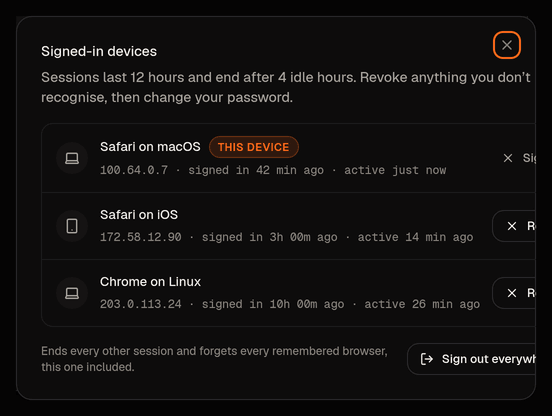
A signed-in device is a session. Sessions end after 12 hours, or after 4 hours of doing nothing; two minutes before the idle limit a banner counts down with a Stay signed in button, and reaching zero returns you to the sign-in page. Both timers are server settings (idle 15 minutes to 12 hours, lifetime 1 to 24 hours) and the console reads the live values, so trust the account menu and the banner over any fixed "30 min idle" label on a Settings card. Signed-in sessions lists every device signed in as you with a Revoke button, plus Sign out everywhere else, which also forgets every remembered browser. Revoke anything you do not recognise, then change your password.
Remembering a browser
At sign-in you can tick Remember this browser for 30 days. On that browser, later sign-ins ask only for your password. It is for your own phone or laptop; do not use it on a shared computer. A remembered browser never substitutes for a fresh code: the first sensitive action in each session still asks for one. The token rotates on every use, at most ten browsers are kept, and all are forgotten when you change your password, reset your authenticator, or sign out everywhere else. Forget one, or all, from Trusted devices. The operator can switch the feature off server-wide.
Sensitive actions ask again
Some actions need a code check: a fresh authenticator code, which then stays good for 30 minutes in that session. The account menu shows "Verified for sensitive actions" and the minutes left. Code check is required for, among others:
- resuming trading after a , and flattening,
- loosening any limit, a looser , or taking a name off the ,
- raising or creating a (also when it comes from a card),
- setting an to Required,
- connecting, re-verifying or disabling a broker connection,
- confirming a Consult card that changes a setting in the looser direction,
- changing your password, inviting an operator or viewer, sharing your book.
A few critical actions want a code from the last 5 minutes, even if you verified a moment ago: switching autonomy to Full, resetting your authenticator (which also asks for your current password), reissuing anyone's setup link (the link re-enrols password and authenticator, so it amounts to handing over that account), inviting another owner, disabling or enabling a user, minting an API token, and every owner action on the Admin . Halting never asks; stopping should always be easy, from Risk or the top bar.
An open live-update stream re-checks itself about every 30 seconds: if your session has expired or been revoked, or your view of a shared book has been withdrawn, the stream ends and the next request sends you to sign in (or back to your own book).
API tokens
An owner can mint bearer tokens for machine clients; today that means only the cloud ops routines that fetch the readiness and triage packets. Open API tokens in the account menu (the same menu that holds Signed-in sessions): the dialog lists each token's name, its first characters, scope, last use and expiry; Create takes a name, the scope and an expiry (30, 90, 180 or 365 days, or never; 90 by default) and asks for a code from the last 5 minutes. The only scope is ops:read: read the two ops packets and nothing else. A token is refused on every other route, and it can never sign in to the console, change a setting or reach the broker. The token itself is shown once, with a copy button and the instruction to store it as the routine's environment variable; only its hash is kept, so a lost token is revoked and re-minted, not recovered. Revoke ends it immediately; an expired or revoked token, or one whose owner is disabled, answers 401. Minting and revoking are both audited.
The sign-in audit
Every login, failure, lockout, code check, session revoke and device change is a row you can read at Activity › Sign-ins. Owners also see it merged with config changes on the Admin screen's audit tab. No app role can delete an auth row.
What is exposed
The console is served over HTTPS on its own domain with only ports 443 and 80 open; SSH reaches the VM through Google's IAP only. The session cookie is HttpOnly, Secure and SameSite Strict, and only its hash is stored. Broker keys live encrypted with the ; the PM (shown as on screen) has never had them and never will. The console API cannot read the secret store at all.