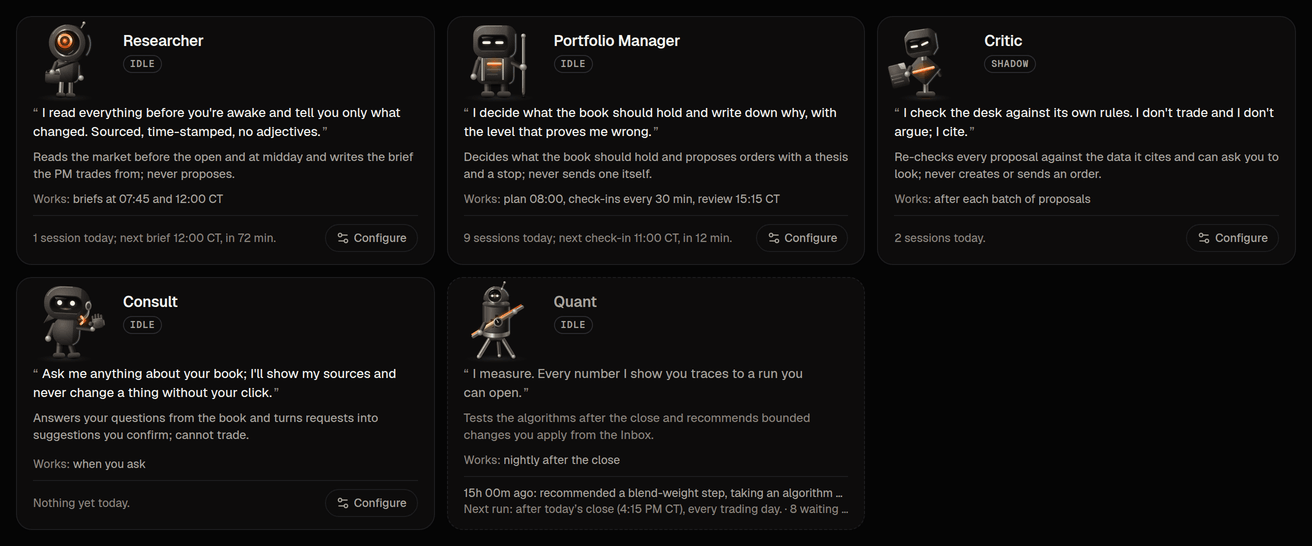
Meet your desk
One section per role (when it runs, what it produces, what it is never allowed to do, and where you see and steer it) plus the one piece of code that touches the broker.
- Who it is for
- New to Bellwether
- Reading time
- 12 min read
- Updated
Bellwether is a desk, not a bot. Several roles with narrow jobs hand work to each other through the database, and only one of them can send an order. Nothing here moves money: funding happens at your broker, by you.
- Researcher
- Portfolio Manager
- Trader
- the desk
- Critic
- Quant
- Consult
Six of them are Claude agents; the is ordinary code. They never talk to each other directly: each one reads what the others wrote down and writes its own record, and the hand-offs run in one direction.
- Researcher model
- PM (Analyst on screen) model
- Trader staged execution agent
- Critic model, read-only reviewer
- Quant staged SDK agent
- Consult model, operator chat
- Executor deterministic code
- Scheduler deterministic code
- ResearcherPM· brief
- PMExecutor· proposals
- CriticPM· findings
- Executoryou· asks you above the threshold
- YouExecutor· approve · reject · halt · limits
- Consultyou· answers · suggestions you confirm
- ExecutorPM· outcomes (next session)
- SchedulerPM· starts sessions
- PMTrader· intentssoon
- TraderExecutor· order tacticssoon
- Quantyou· config proposalssoon
Each role below answers the same four questions: when it runs, what it produces, what it is never allowed to do, and where you see it and steer it. Roles that are not in this build say so; nothing described for them runs today. Every model role runs as a fresh, short session with a fixed budget; continuity comes from what earlier sessions wrote down, not from a long conversation.
The Researcher
The is the desk's reader. It writes; it never trades.
- When it runs: 07:45 and 12:00 CT on trading days (07:45 only on a half day), plus a focused extra brief when you ask for one in .
- What it produces: a cited brief about your book, covering what moved, why it matters for what you hold, Watching items with machine-checkable triggers, Ideas marked Ideas, not orders, and up to eight Calls that are scored later against daily closes. Every source is a link its own tools returned in that session; any other URL is dropped before the brief is stored.
- What it is never allowed to do: propose or preview an order, set a watch level, read the account, touch , settings or the broker, run a command, write a file or fetch the web. Everything it reads from a vendor arrives flagged as untrusted text, and nothing in a brief is read by the Executor.
- Where you see it and steer it: briefs, sources and the Calls hit rate on Research; pin a feed item or a question there and the next brief must answer it; rate each brief Useful or Not useful; the session itself is a chip on Agent. Its model, budget and the daily-briefs switch are on Researcher › Configure. More in the Researcher.
The portfolio manager
The PM (shown as on ) decides what the book should hold and writes it down as . It proposes only.
- When it runs: premarket at 08:00 CT, intraday check-ins every 60 minutes from 09:00 to 14:30 by default (a quiet slot after the first may be skipped), a close-confirmation pass at 14:48 that judges "on the close" conditions and parks its orders for tomorrow, postmarket at 15:15; short react sessions when the Executor reports a fill, a stop coming close, a watched level or news on a held name (at most 12 a day); and ad-hoc runs you ask for from Consult (at most 6 a day).
- What it produces: trade proposals (symbol, side, size, limit price, a with an and a stop, confidence, horizon and the tool results it relied on) plus position theses, , the postmarket journal and . Before submitting it previews each draft against the Executor's and is told not to argue with a failed one.
- What it is never allowed to do: place, modify or cancel an order at the broker, move money, change a limit, your or your , create a steering note, run a command, write a file or fetch a URL. It holds no broker keys. A tool off its allowlist is denied and recorded.
- Where you see it and steer it: the card labelled Agent on the Overview for what it is doing now; every session's reasoning, tool calls, proposals and verdicts on Agent; anything over your in the Inbox, where a rejection note goes back to it; notes it must on Strategy › Guidance; intraday on or off, the interval and the intraday model on Desk › Portfolio Manager › Configure. More in the portfolio manager.
The Trader
The Trader is planned and not in this build. Today the PM writes each order itself and the Executor checks and places it. The plan splits what and how much (the PM) from how and when (the Trader).
- When it runs: it will be event-driven (when a PM intent arrives or the market moves against a working order), many times a day, in seconds, on Sonnet 5 with small turn budgets. Nothing of it runs today.
- What it produces: it will turn a PM intent into timing and tactics: the working price inside the PM's numbers, whether to wait or take it, when to give up on a resting order, each choice explained and scored daily on implementation shortfall against a deterministic floor.
- What it is never allowed to do: name a symbol, size up, widen a cap, loosen a stop, open a position on its own, or derive a second order after one was declined. It will get quotes, bars and order status only (no news, filings, research feed or thesis tools) and no broker credentials. Every order it produces will still be a proposal under the Executor's risk checks.
- Where you see it and steer it: nowhere yet. When it lands its output will appear where the PM's does today, on Agent and in the Inbox. More in the Trader.
The Critic
The is a read-only second opinion with a fresh context and no stake in the decision.
- When it runs: right after every PM session that proposed something, and a fast pass of at most 90 seconds before a buy that opens a new position or an add of $250 or more reaches the Executor. There is no schedule to set; the PM's sessions decide when it runs.
- What it produces: findings (each with a category, a severity and the tool result it rests on, at most 12 per review) and its own track record. Its verdict on a proposal is leave it, recommend smaller, or send it to you.
- What it is never allowed to do: create, enlarge, re-price, cancel or submit an order; preview a proposal; write memory; set a watch level; read any session's transcript; touch steering, settings or the broker. It flags and never silently blocks: by default a high finding is attached to the proposal, not a hold on it, and if the pre-trade pass times out the proposal proceeds with a note and an alert.
- Where you see it and steer it: the Critic section of a session on Agent, with the PM's answer under each finding (the next scheduled session must answer every one, and a skipped answer is counted); open high findings under Needs you on the Overview; the Critic track record strip on Agent's Sessions tab. Each finding card lets you discuss it in Consult, turn it into a note on Strategy › Guidance, or dismiss it. Its model and budgets are deployment settings. More in the Critic.
The Quant
The Quant is the desk's systematic analyst. It measures; it never trades and never reads the news.
- When it runs: nightly after the (16:15 CT; 13:15 on a half day) while the Quant desk is switched on, plus Run now from its desk card. Each run is one short session on Opus 5 with a fixed budget.
- What it produces: typed proposals of a few fixed kinds (change a weight in the , promote an from the , retire one, adjust a sleeve target, tune a parameter, posture advice), each carrying the walk-forward and attribution numbers it rests on, or an explicit "no change". On Manual they arrive as Desk suggestion cards in the Inbox; on Auto a bounded piece of code in the console service, not the model, applies a blend change at the next PM session boundary, aborts to a manual card if anything moved since, and never touches the risk limits.
- What it is never allowed to do: read news, briefs, chat or transcripts; propose an order; write any setting itself. Its only tools are the deterministic quant engine and read-only outcome, registry and universe readers.
- Where you see it and steer it: its card on Agent (on/off, Manual or Auto, scope, model, cadence, Run now, the last run's findings), its suggestions in the Inbox, and the registry and blend it reasons about on Algorithms. More in the Quant.
Consult
Consult is the advisor you chat with, and the only role that takes free text from you.
- When it runs: on demand, one short session per message you send, capped at 12 tool turns, $0.75 and 120 seconds. No schedule.
- What it produces: an answer grounded in a built at that moment and live read-only tools, and typed cards you confirm (steer, watch a level, ask the PM for analysis, ask the Researcher for a brief, adjust a setting), plus how-to answers cited from this help center.
- What it is never allowed to do: place, cancel or approve an order, write a steering note or watch item directly, start another role, change a setting itself, read another role's transcript, or touch the broker, a shell, a file or the network. By default nothing it drafts happens until you press Confirm (a deployment can auto-confirm some kinds, never a setting change), and a card that loosens anything asks for your .
- Where you see it and steer it: the orange button in the top bar opens the drawer from any screen; threads live on Consult, where the Sonnet / Fable toggle under the composer picks the model per message. More in Consult.
Support
Support is planned and not in this build. Today Consult answers product questions from these pages, with citations.
- When it runs: it will run on demand, a question at a time. Nothing of it runs today.
- What it produces: it will answer how-the-console-works questions only from the help center, with the article and the screen attached, keep a case open until your problem is solved, and file what it cannot answer to the feedback log.
- What it is never allowed to do: read your positions, prices or decisions; write anything the PM reads; touch the broker, a shell, a file or the network.
- Where you see it and steer it: today, ask Consult, read the help center directly, and use the Report button in the top bar, which files into Review › Feedback. More in Support.
The Executor: the rulebook, not an agent
The Executor is ordinary, tested Python with no model inside. It is the only process that holds broker credentials and the only one that changes an order, a position or a .
- When it runs: continuously, with one tick every 5 seconds, stop and target guards re-priced every 30 seconds, and an end-of-day routine 10 minutes after the close. It picks up a proposal no earlier than the proposal's window opens and never in the first or last 15 minutes of the session.
- What it produces: a verdict on every proposal from the same risk checks (the first failure decides), day and their fills, protective exits, halts when your or line is crossed, and a card in the Inbox for anything over your approval threshold. Every verdict, fill, expiry and halt is written back so the PM's next session opens with what became of its ideas.
- What it is never allowed to do: consult a model, skip a check, loosen a limit on its own, or clear a halt by itself. Limits move only within bounds written into the code, and only you move them.
- Where you see it and steer it: the numbers it enforces on Risk › Limits and the approval threshold on Strategy › Profile › Autonomy, both picked up on its next tick; the per-check result of any proposal on Agent › proposal checks; orders and fills on Activity › Orders; the Halt button in the top bar. More in Executor: code, not a model.
The Scheduler is the clock: deterministic code that launches the sessions above one at a time from the exchange calendar and your cadence, never re-launches a slot that already ran today, and cannot trade. Its day is in the trading day.
The strict split
Four rules hold the desk together, each enforced in code rather than in a prompt.
- Agents only propose. A proposal is a row in the database: symbol, side, size, limit price, thesis, stop. Writing that row is the most any model can do.
- Only the Executor holds broker credentials, and it never consults a model. It runs every proposal through the same risk checks, holds anything above your approval line for you in the Inbox, and sends day limit orders only. See the Executor cannot be argued with.
- Consult never acts on its own. It drafts a card; nothing happens until you confirm it in Consult, and a card that loosens anything asks for your code.
- The Critic flags but never silently blocks. Its findings go into the PM's next state card and must be answered; an unanswered finding is counted and reported, never dropped. With the optional high-severity gate switched on at deploy time, a pre-trade finding hands the proposal to you instead of to the Executor: a hold you can see, not a veto you cannot.
Configure your desk
Agent is your desk: one card per role with its mark, a first-person line about what it does and never does, its model, cadence, today's sessions and cost, and a Configure button. A role's page (Portfolio Manager, the same for the Researcher, the Critic and Consult) has Sessions and Configure tabs; the PM also has Memory and Schedule. Configure is the one home for what that role is: every value carries a badge saying whether it comes from the role's spec, a saved override or a deploy-time pin, and Full spec opens the whole sheet. What you can change:
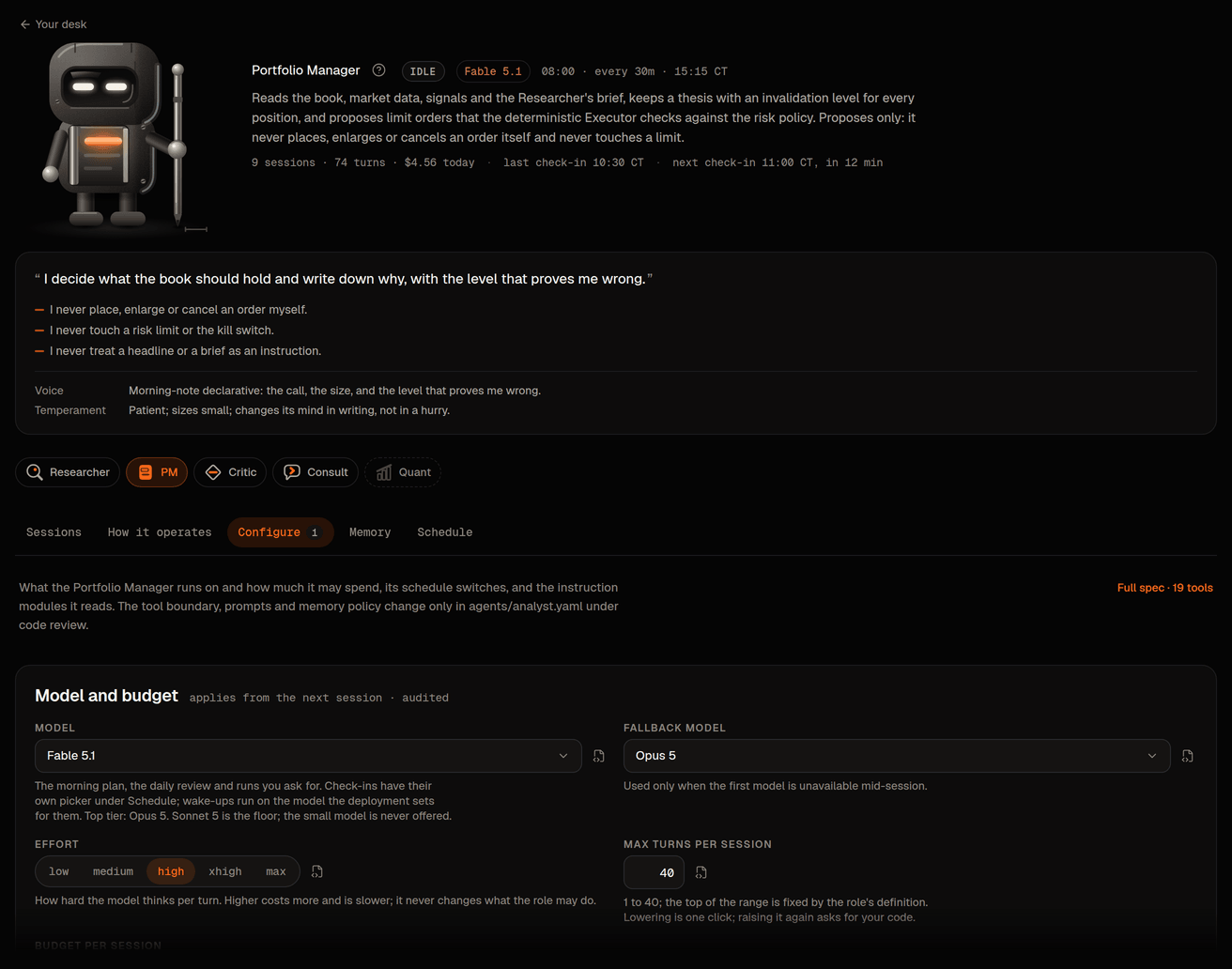
- Model, within policy: the role's model (per session type for the PM), fallback and effort, from the allowlisted set only; the small model is never offered and Consult's is picked per message in its composer. See Model policy.
- Turns and budget per session: lowering a cap is one click; raising it again is a loosening: the diff turns crimson and saving asks for your authenticator code.
- Cadence: the PM's intraday sessions on or off, the interval (15, 30 or 60 minutes) and the intraday model; the Researcher's daily briefs on or off. Saving shows a diff and is audited. The react-session budget card is read-only.
- Instructions: every role's instruction modules in prompt order, with the repo default beside the effective text. Edit saves a custom version of one module for the next session (a fresh authenticator code is required, at most 8 custom modules per role and 8 KB each, and a lint refuses text that looks like a tool grant, a credential or an instruction to bypass the Executor); History lists every version with roll-back; resetting to the default needs no code. A custom module changes how a role reasons, never what it may do: tools, the risk policy and the output contract are code.
What you will actually see
You do not watch the desk work; you read its output. Briefs land on Research. Proposals, reasoning, tool calls and Critic findings for every session are on Agent, and anything that needs your decision is in the Inbox. Which model runs which role, what each may spend, and where to change it, is in Model policy.