The Researcher
The twice-daily cited brief. What it reads, why its sources can be trusted, and why an idea in it is never an order.
- Who it is for
- New to Bellwether
- Reading time
- 5 min read
- Updated
The is the desk's reader. Twice a day it works through what the market did, what was filed and what is coming, and writes a short, cited brief about your book. It writes; it never trades.
- Owns
- The cited brief at 07:45 and 12:00 CT, its Watching items, Ideas and scored Calls
- Reads
- The research feed (headlines, filings, earnings dates, macro releases, movers), quotes, daily bars, your positions and prior decisions
- Tools
- News and the research feed, market data, filings and fundamentals; no order tool, no network, shell or files
- Model
- Fable 5.1
- Cadence
- Twice a day, 07:45 and 12:00 CT; 07:45 only on a half day
- Change it at
- Researcher › Configure for the model, effort, turns and the session cap (lowering is one click, raising asks for your code), and briefs on or off; the two brief times are fixed
- Hands off to
- The PM: the brief is the news baseline in its
- Judged by
- The hit rate of its Calls against daily closes, and your Useful / Not useful rating
What it reads
The Researcher starts with your account, positions and recent decisions, so the brief speaks to positions and ideas that actually exist. Then it reads the research feed: headlines, SEC filings, earnings dates, macro releases and unusual movers, already pulled into one corpus. It pulls raw headlines only for names the feed did not cover (held names, the , SPY and QQQ), quotes for the names that matter, daily bars for what moved, and the record as filed (8-K items, reported revenue and EPS) when a held or watchlist name has results in the window.
Everything it reads is stored sanitized and marked untrusted. Headlines are context and risk, not ; an instruction hidden in a headline is something the brief is told to call out, not follow.
Tools
Its news tools are get_news and get_research_feed; the rest is the PM's market, filings, brief-index and memory set. The preview refuses in this job and the brief prompt forbids it; there is no network, shell or file tool, and everything it fetches from a vendor comes back flagged as untrusted text.
When it runs
- 07:45 CT: the morning brief, with the overnight tape, filings, the macro calendar for the next three sessions, and what it means for what you hold.
- 12:00 CT: the midday brief, with what changed since the open. On a half day there is no midday brief.
Each brief is a fresh session on Fable 5.1 with a $5.00 and 40-turn cap, drawn from the same $25.00 daily model budget as the PM; the model, effort and caps are set on Researcher › Configure (see Model policy). You can also ask for an extra, focused brief from Consult. A brief appears on Research as soon as it is stored; the session itself (tool calls, cost, turns) is on the Researcher's page of your desk like any other.
What a brief contains
A brief has fixed headings, in this order: What moved · Why it matters for our book · Watching · Ideas · Calls · Sources.
- Watching items are machine-checkable: one symbol, one trigger, and what it would unlock.
- Ideas carry a direction (long, trim, exit, avoid or watch), an honest conviction between 0 and 1 (rarely above 0.7), a horizon, the reasoning (evidence from prices and prior decisions first, headlines second) and an explicit . The section ends with the literal line Ideas, not orders., and "no ideas today" is a good outcome.
- Calls are up to eight checkable statements the Researcher is willing to be scored on ("NVDA above 130 within 5 days"), each resting on a stored source item; a call without one is dropped.
Citations you can trust
Every source in a brief is a URL that its own news tools returned in that session. The server drops any other URL before the brief is stored and writes a warning, so the model cannot launder a link out of headline text into Sources, and it cannot fetch the web.
Ideas are context, never orders
Nothing in a brief is read by the , and the brief session cannot propose an order. To act on an idea, a later PM session has to propose it, preview it against the and, above your , wait for you.
What the brief is for is the 08:00 premarket session. The 07:45 brief is injected into the PM's state card as its news baseline, so the PM does not re-read the morning's headlines; the midday brief does the same for the afternoon. A proposal that rests on the brief records the brief id, so you can trace the chain from headline to order.
Where you read it
Research is the hub: the feed by day, the calendar, the briefs with their sections, and the Regime strip. Pin a feed item, or a question of your own, and the next brief has to answer it explicitly, in writing. See pins and the feed.
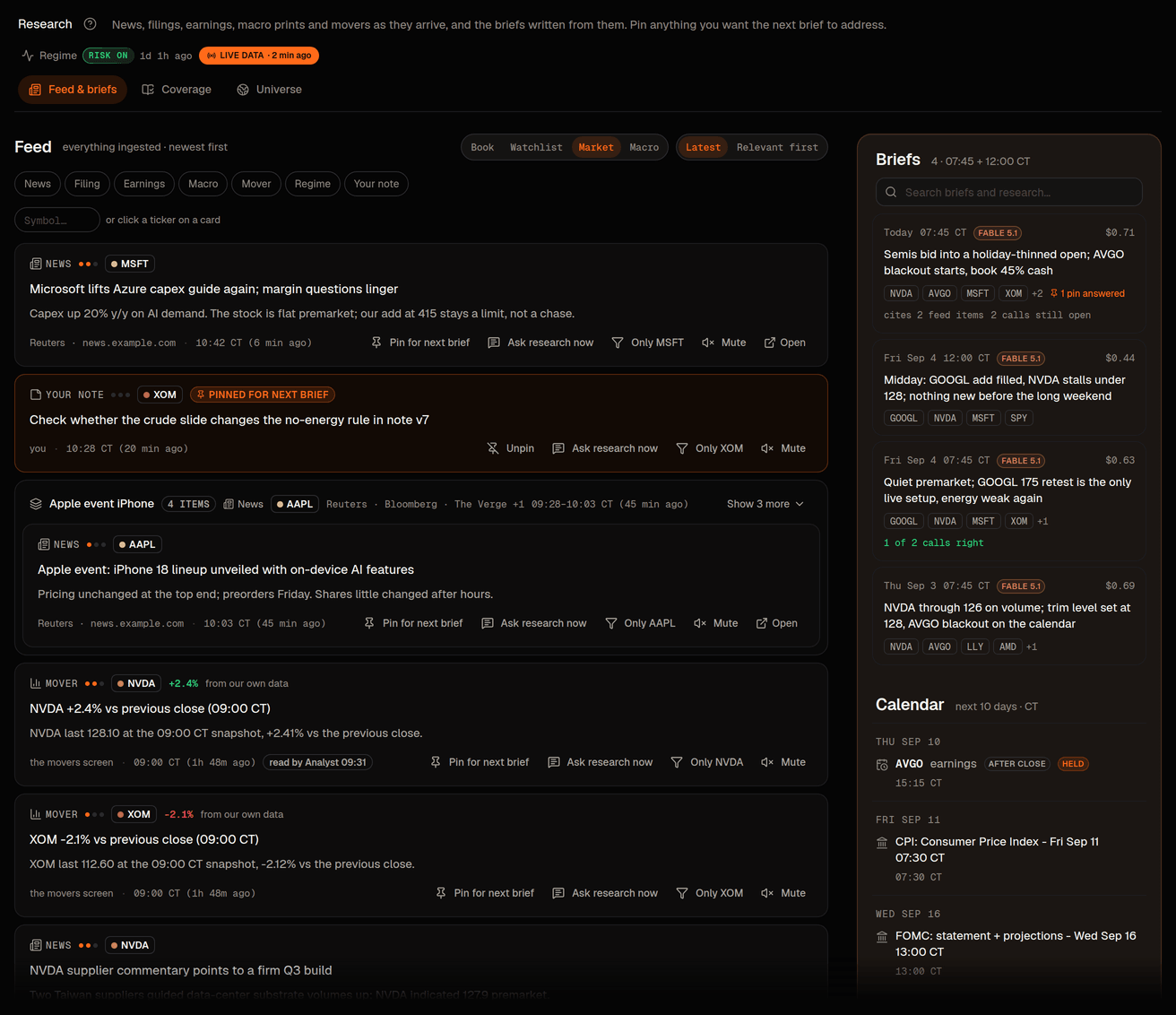
How it is judged
By its Calls. Each one is checked against daily closes at its horizon, and the hit rate is shown on the Research hub next to the brief. Your Useful / Not useful rating on each brief is the other signal.
Failure modes you might see
- Stale brief: a brief older than 6 hours, or a missing one, is flagged in the PM's state card, and the PM goes back to raw news for held names and says so in its summary.
- Dropped source: a URL its tools did not return is removed before the brief is stored, with a warning in the session.
- Skipped pin: a brief that lands without answering a pin raises a warning; a pin two briefs pass without answering expires.
- Budget spent: when the day's model budget is gone the brief is refused rather than started; the PM's card flags the missing brief.
Briefs keep coming while trading is or disabled; there is nothing in them to block.