Paper vs live
Paper is the default everywhere and nothing in the console switches to live; what the environment pill means, what the readiness scorecard measures, and the deploy-time ceremony that stands between a green scorecard and real money.
- Who it is for
- Owners & operators
- Reading time
- 7 min read
- Updated
Everything starts in paper. Paper is the default environment in the code, the example env files, the container definitions, the infrastructure and the service units, and the default broker is the built-in simulated one. No console setting switches to live: Connect refuses live keys unless the deployment explicitly enables live connections, the refuses to start live against the simulated broker at all, and it refuses to start when the keys it is given are paper keys under live or live keys under paper. Going live is a separate deployment with a separate key, done by a person, after evidence.
The environment pill
The pill at the left of the top bar says which world the book is in:
- PAPER: outlined. A ; no real money.
- LIVE: filled orange and pulsing. A real brokerage account.
- ENV MISMATCH: amber. The environment flag and the Executor process disagree.
A mismatch is not cosmetic. Risk check #1 (broker_env_matches_process) compares the flag with the running process before anything else and halts on the first it sees until they agree. Accounts then answers "Can it trade now? No" in one sentence that names both sides (the book is set to real money, the trading service is on paper money, so every order is refused until the book's owner sets them the same), links here, says paper or live changes only through the procedure, and offers no button.
The readiness scorecard
Go live is owner-only (there is a link to it from Performance). It scores a fixed set of gates from what the system already records (the page says how many) and opens with where the book stands: a verdict, one sentence that says whether the book can trade real money yet and whether anything is wanted from you, how many gates pass today, the passing days in a row out of the 5 required, and a sparkline of the last 10 trading days. Beside it (under it on a phone) the gates are a table (Gate, Now, Needs, Looks at) that leads with the ones that need work and the passing ones behind a Show all rows button that says how many there are (every gate and one row shown for information). The thresholds they are held to are on the second tab, Thresholds, under the same names. A gate passes, passes but could be better (above the level to aim for), fails or is not measured yet, and a gate that cannot be measured yet never passes. One more row, the AI cost per filled order, is shown, not counted: dollars per fill would punish a desk that rightly sat out.
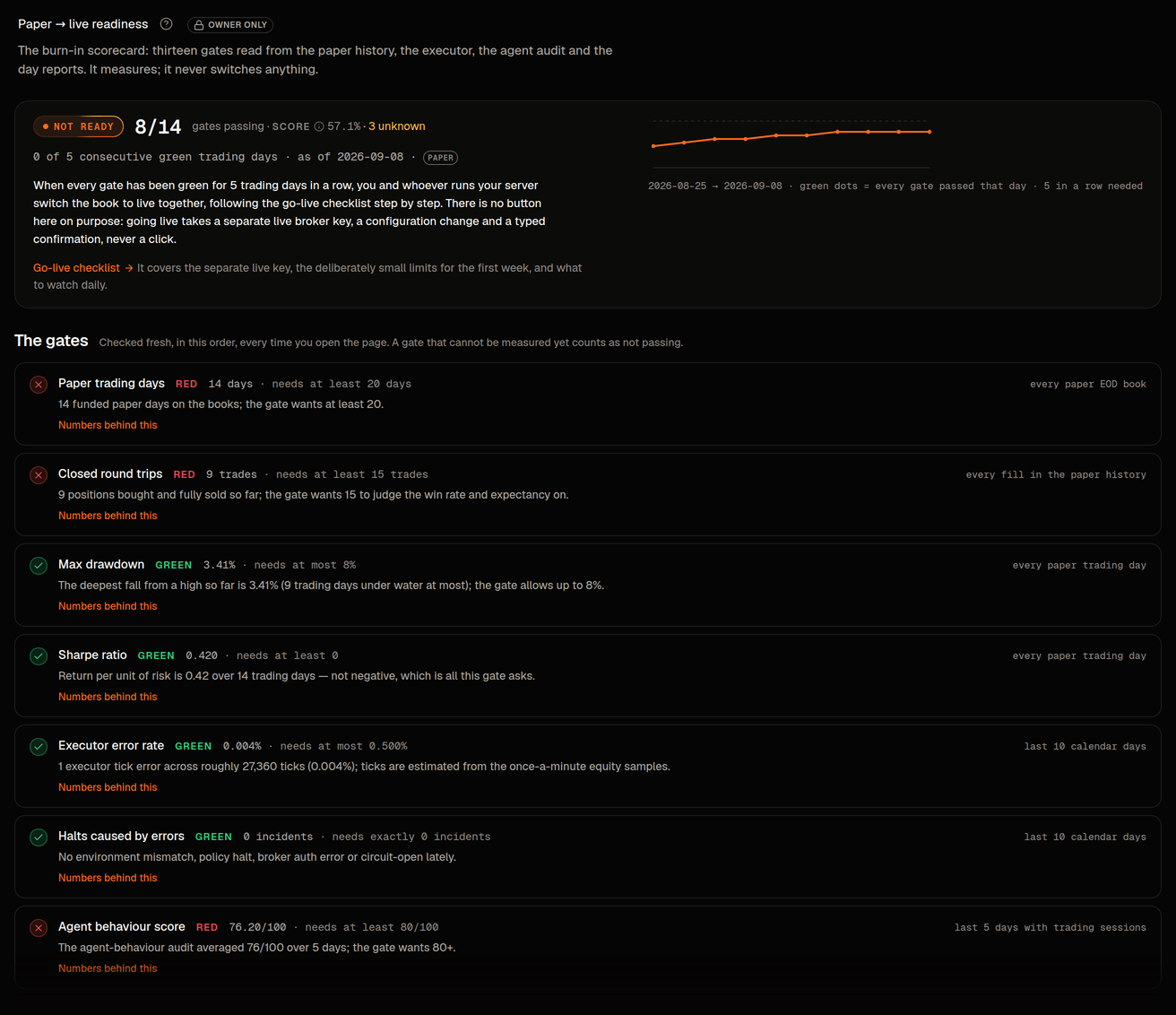
The gates, with their code-default thresholds:
Days traded on paper
- Passes when
- at least 20 funded paper trading days on the books
Finished trades
- Passes when
- at least 15 completed round trips (a buy and the sell that closed it)
Deepest fall from a high
- Passes when
- no worse than 8% over the paper history
Return for the risk taken
- Passes when
- the Sharpe ratio is at or above 0
Order-handling errors
- Passes when
- at most 0.5% of the order handler's passes errored in the last 10 days
Halts caused by errors
- Passes when
- no paper/live mix-up, refused broker key, broker outage or rule breach that stopped trading in 10 days (loss and halts do not count)
How the desk behaved
- Passes when
- the desk's behavior review averages at least 80 over the last 5 days with trading sessions
notes the desk answered
- Passes when
- every one of the desk's last 5 sessions your guidance notes (the figure is the share that did; 100% passes)
Proposals that got a second opinion
- Passes when
- the reviewed at least 90% of proposals over the last 5 days
Critical findings in
- Passes when
- no critical finding in the last 5 day reports
Broker and book agree
- Passes when
- no mismatch between the broker's statement and the book in 10 days
AI cost per decision
- Passes when
- AI spend per decision at most $0.80 over the last 20 trading days; fewer than 30 decisions reads not measured, never failed
AI running cost, share of equity a year
- Passes when
- under 0.5% passes, up to 1% passes but could be better, above that fails; real money needs under 0.5%; not measured below 5 end-of-day books
Planned AI spend fits the book
- Passes when
- the schedule in force, priced at this book's recent session costs, is at most 1% of equity a year on paper (0.5% live)
Release checks on this version
- Passes when
- the version you are using passed its checks before release, no more than 3 days ago
Backtests against the published studies
- Passes when
- the latest comparison against the four published studies passes and covers the price history's end
AI cost per filled order (shown, not counted)
- Passes when
- shown against a $2.00 reference from 20 fills on; never counts towards the verdict
A decision, for the cost-per-decision gate, is a proposal, a reasoned decision not to trade a name (counted once per name per day) or an automatic exit that acted, so a desk that reads the tape and rightly sits out is not scored as expensive. The running-cost gate takes what the models cost over the trading days the book has existed in the window, annualizes it, and divides by the average end-of-day book: that is the number an investor compares with a fund fee, which is why real money needs it under 1%.
Each gate shows its figure, what it needs and where it looks. A gate that cannot be measured yet says in a sentence what it waits for. One fold per row holds the rest: Why on a measured gate (the sentence and the numbers behind it), Details on one that is not measured yet. The three AI-cost rows open onto the model spend by role for the window (brief, premarket, intraday, close, critic, ) so you can see where the dollars went. The deployment can tighten a threshold; an attempt to loosen one is ignored. The page measures and never switches anything (there is deliberately no button), and it keeps scoring the paper history after a cut-over, so it stays your "was the paper record real?" reference.
The ceremony
Accounts states which world the book trades in as a word on the summary, and its Going live panel says in one sentence that going live is a separate checklist and never a switch on that , and links to the go-live checklist; it shows no steps, settings or buttons. The procedure itself (this manual calls it the ceremony) has four parts:
- Readiness evidence: every acceptance item checked by you after reading its evidence.
- Live account: active and funded as the broker reports it, with a separate live key in Secret Manager the console never reads.
- Arm the flag: set the environment flag to live behind a typed GO LIVE and your . On its own this trades nothing: the Executor is still on paper, the pill reads ENV MISMATCH and check #1 halts everything.
- Redeploy the Executor with its own environment set to live. This is done in the deployment on the trading machine, not in the console. The mismatch clears when the process reports live.
None of it happens in the console: the API does not compute the readiness-evidence checklist yet and has no route that arms the flag. The cut-over itself is three separate acts on the VM: a reviewed code change that adds the live profile, a config change on the machine that sets the Executor's environment to live (never in the repository), and a , for which the Executor is to print the live account and refuse to run until a person types the exact sentence back. That confirmation gate is planned, not built, and the runbook may not be run until it lands. Nothing in the repository, API or console flips the environment for you.
Rolling back to paper needs no ceremony and nothing has to be green: , set the Executor's environment back to paper in the deployment, restart. It is always allowed.
Why it is never one click
Each step is a different act by a different mechanism (evidence you read, an account the broker vouches for, a flag and a process that must agree, a sentence you type on the machine), and any one alone does nothing. The first live week runs on tiny limits set on Risk › Limits and Risk › Halts (the runbook says at most $100 an order, 5% a position, 25% gross and 2 orders a day, with the halts at a $50 and 4% drawdown), with the at $0 and on manual on Strategy › Profile, so every order waits in the Inbox. Performance for the live book is compared with the paper week before anything is loosened, and then only one notch at a time, each behind code check and audit, never more than one loosening a day, and only after five clean live days.