Markets and the symbol sheet
A Markets view of indices, movers, sectors and universe screens next to what the desk is watching, one sheet for any ticker with our own signals on it, and four typed actions (watchlist, research, ask the PM, trade) the desk answers in the Inbox.
- Who it is for
- Owners & operators
- Reading time
- 6 min read
- Updated
Markets sits in the Explore group of the rail (or type "markets" in the command palette). The symbol sheet opens from any ticker chip's Open detail, from every Markets and position row, from the command palette (type a ticker) and from ?drawer=NVDA on any address. What each action set in motion is tracked under Your requests at the bottom of the Inbox.
Two surfaces. The Markets view answers "what is the market doing and what is the desk looking at" without opening a brief. A symbol sheet answers "everything Bellwether knows and thinks about this one ticker" from any ticker chip, and carries four actions that turn your interest in a name into something the desk must answer, without giving you, or anyone, a way around the .
The Markets view
One read-only built from data the platform already holds; every price on it is a completed-session close with its date and source, never a live quote:
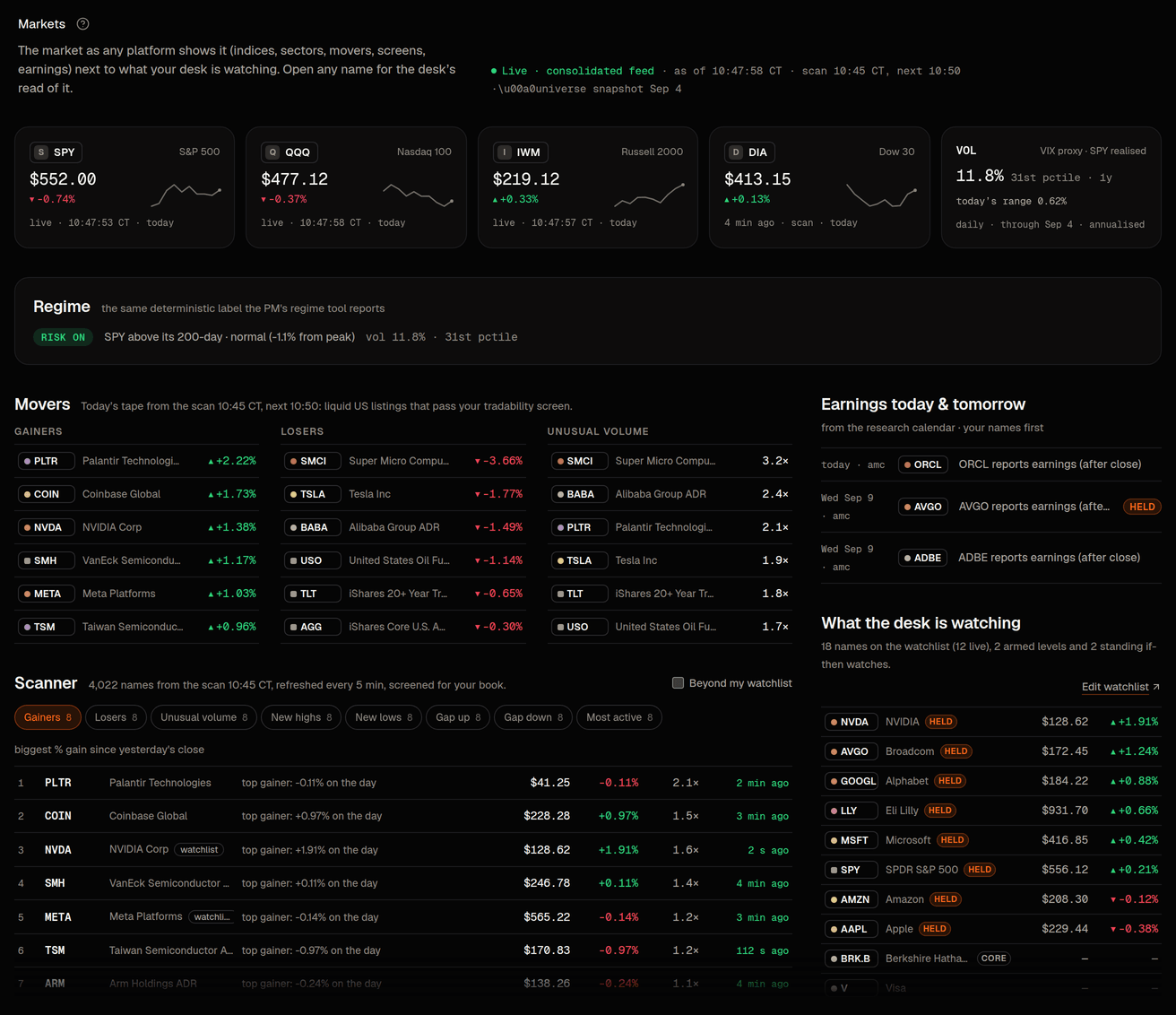
- Index strip: SPY, QQQ, IWM, DIA with the day's change, plus a volatility proxy (SPY's 20-day realised volatility and its one-year percentile, labelled a proxy).
- Movers: gainers, losers and unusual volume from the nightly snapshot under this book's own thresholds and , the same list the PM (shown as on screen) gets from
get_movers. - Sector heatmap: the sector ETFs as tiles sized by weight and coloured by the day's change, so a rotation is visible at a glance.
- Universe screens: top and bottom names by momentum, RSI(2), volume surge and the other metrics of the nightly universe job, over the set this book could actually trade. These are the screens that exist today on Research › Universe (see the universe view); Markets shows a compact pick of them and links through.
- Earnings today and tomorrow: market-wide, with held names marked, from the same calendar the reads.
- What the desk is watching: the PM's open watch levels and standing if-then watches, and the names the latest brief flagged, in one strip.
Every row opens the symbol sheet. Nothing on Markets trades, changes a setting or costs a model session.
The quick look and the symbol page
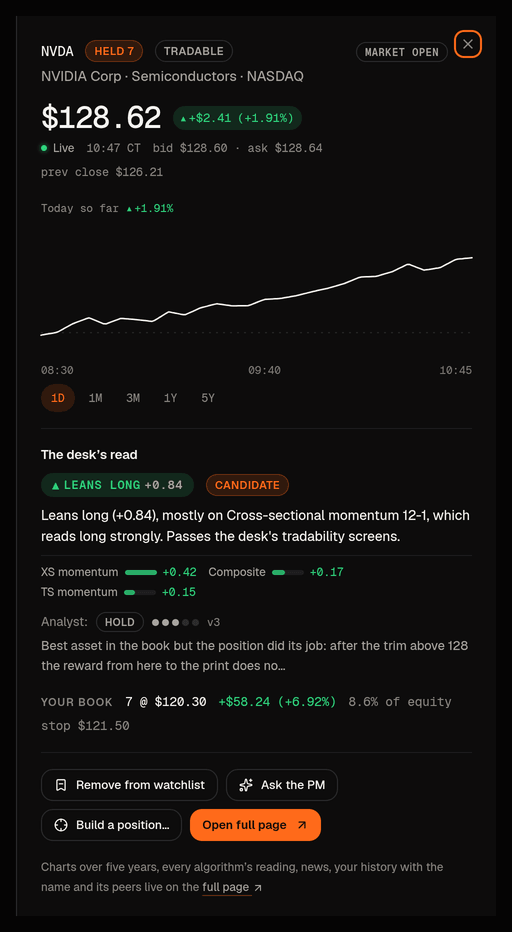
Click any ticker chip (in the feed, a brief, a , Activity, Markets) and choose Open detail for the quick look or Open full page for the page at /symbol/NVDA. The quick look keeps the price with a plain feed label ("Live", "12 s ago", "Closed · last close Sep 9"), a compact chart, one line of the desk's read and three actions; the page carries the charts over five years, every 's reading with the rule machines beside the , check by check, why it moved, your whole history with the name and its peers. Both are described in the symbol page and the quick look.
Four actions, each a typed intent
The sheet's actions do not do the thing; they record a typed ask with you as the author, and the owning role answers it where you can see the answer. This is the same intent layer Consult cards use, so the guards (duplicates refused, daily caps, where it loosens anything) are identical.
| Action | What it records | Who answers, and where |
|---|---|---|
| Add to | The name joins your Watchlist (tiers and caps stay on Strategy) | Immediate; the PM's next lists it, and the feed's Watchlist scope includes it |
| Mark for research | "Look into this name" with an optional note | The Researcher: the next brief must address it, exactly like a pin, and the answer is linked from the Inbox card |
| Ask the PM now | An ad hoc PM run with the name and your question at the top of its prompt | The PM: a session now (or at the next open), under the same daily cap as Consult-triggered runs (6 today); its answer and any proposal appear in the Inbox with "asked by you" provenance, and a proposal goes through the , the Inbox and the Executor like any other |
| Trade… | An operator order: side, quantity, limit, stop and target | The Executor, directly; see below |
Provenance is the point: every card that results says who asked (you), when, from which sheet, and what the role did with it, so "the desk ignored my idea" is checkable rather than a feeling.
Trade… is an operator order, not a shortcut
The sixth verb (operator decision, 2026-09-09) lets you place, close or reduce a position yourself; Trade… on the sheet opens the same Trade sheet as the top bar, and place a trade yourself has the whole flow. It is disabled, with the reason in words, when the deployment has manual orders switched off or the book is live, and it is not shown to a login without trading rights. The shape:
- Your order becomes a proposal with you as its author, stored next to the PM's. It passes through the unchanged Executor and every one of the : order cap, position cap, , tradability, halts, hours. A check that fails refuses your order with the same reason code it would give the PM.
- There is no approval step (you are the approver), but each order asks for your authenticator code and writes an audit row.
- The stop and target you give arm the same protective exits the Executor manages for PM entries.
- The PM adopts the position at its next session and manages it under its own , unless you tick manage myself, in which case any agent-authored modify or close on that symbol is until you clear the flag.
- The Executor remains the only process that talks to the broker. still cannot place an order; it can draft the same operator-order card for you to confirm with your code.
The Watchlist (formerly Focus list)
The list on Strategy › Watchlist (the old Focus list; the old address and the palette still answer to that name) is linked from Markets ("Edit watchlist →"), the symbol sheet and the command palette. What it does is unchanged: it is the set of names the PM spends attention on: listed in its state card, covered by its earnings-calendar tool, used as the Watchlist scope of the research feed and for headline importance (+1 for a watchlist name). It is not a gate: since the open-universe decision every data tool accepts any US ticker, and the Executor's tradability screen, not this list, decides what may be bought. Turning a row off keeps the name on the list but out of focus. The per-row cap field is recorded and shown to the PM, which must honour it; the Executor sizes against the book-wide position cap only.
Also on a ticker chip
Every ticker chip still opens its small menu first: last price and day change when the console has them, then Open detail (the quick look), Open full page (the symbol page), Ask the analyst (Consult with "What is your current read on NVDA?" filled in), Steer… (Guidance prefilled for that symbol), Filter activity (Activity on that symbol) and Add if-then watch… (the form on Research, see standing if-then watches). Screens over the whole market with the "why is this name in or out" panel stay on Research › Universe; the PM runs the same screens with screen_universe.