A team of Claude agents reads the market, writes the thesis, proposes the trade and argues the other side. One deterministic program, the Executor, is the only thing that can touch the broker, inside limits you set. Nothing moves without your line.
Bellwether reads the market the way a professional desk does: the overnight news, the filings, the levels, the tape. It forms a view with conviction, writes down what would prove it wrong, and argues with itself before anything reaches you. When the facts change it changes its mind, and says so. It acts only inside the line you draw. Underneath, time-tested, published market signals are fused with our own desk intelligence: the process is what we build, not a secret indicator.
Every idea arrives with a thesis, a size, a stop and the price that proves it wrong.
It argues before you have to
A Critic reviews every session and every new position; objections are answered in writing, not waved away.
Your line, always
Above your approval threshold nothing moves without you, and Halt is one click from every screen.
Illustrative session · fictional symbol and prices
An illustrative session: the Researcher flags a name, the Portfolio Manager writes a thesis with a stop, a target and what would prove it wrong, the Critic objects and is answered, the Executor runs its checks, and the approved order is parked for the open.
Researcher · 07:45
ACME raised guidance after the close. The level that mattered last quarter is 41.20; pre-market volume is heavy and one-sided.
brief · 3 sources cited
Portfolio Manager · 08:00
Needs you
ACMEBuy40 shares · 2.1% of the book
Guidance raise with the tape agreeing. Start small above last quarter’s pivot and let the first hour confirm it.
Stop
39.60
Target
45.00
Horizon
3 to 5 days
Sells if
it closes back under 41.20, or the volume worry below proves right.
0.70
Critic
Pre-market volume is one block print, not broad demand. Size it as if the move fades by noon.
PM, in writing
Agreed. Starter only; any add waits for the first hour to hold 41.20.
Executor · 08:30
18/18 passed
Same checks as every order, in the same order. The first failure would win; none does.
18/18 passed
1Paper account matches this desk · paper
2Market open, outside the no-trade window · 08:36, past the opening minutes
3Symbol passes the tradability screen · listed, liquid
4Buy or sell only (no shorting) · buy
5Limit order, good for today · limit, day
6Limit price close to the current quote · 41.45 vs 41.38
7Quote is fresh · quote 2s old
8Under the largest-order limit · $1,658 under $5,000
9Position stays under its size limit · 2.1% under 8%
10Book stays under its exposure limit · 34% under 60%
11Under today's order count limit · 1 of 6 today
12Day-trading rule respected · no day trades
13No earnings in the blackout window · none this week
14Daily loss limit not hit · day down 0.2%, limit 2%
15Drawdown limit not hit · down 1.1%, limit 8%
16Not a duplicate of a recent order · no twin in 10 min
17Approval line · above your line · approved by you
20Settled cash covers it · buying with settled cash
Order ticket
Buy 40 ACME · limit 41.45 · day
Needs you
Approved by you
Parked for the open
Sent once the opening minutes pass and the quote is still fresh.
The tape: Prints drifting past: direction and pace, never a quote to act on.
ACME
NOVA
KITE
ORCA
LUMA
PIKE
VELA
JUNO
ARGO
MESA
TALN
BRIO
HALO
QUAY
FERN
DUNE
ACME
NOVA
KITE
ORCA
LUMA
PIKE
VELA
JUNO
ARGO
MESA
TALN
BRIO
HALO
QUAY
FERN
DUNE
On the floor
What the desk keeps in the corner of its eye.
The tape, the sectors, the levels it drew before it acted, and the names drifting toward a trigger. Rendered live on this page; the symbols are made up and no prices are shown.
Illustrative · fictional symbols · no prices
Lines before actionThe desk draws its stop, its target and what would prove it wrong before a single share moves, and sizes the position to the gap.Sector heatWhere the day’s pressure is, rippling as it moves through the groups.ProximityWatched names orbit toward the ring; the desk looks again when one touches it.
The team
Meet the desk
Six Claude agents with narrow jobs, and one plain program with the keys. They are kept deliberately apart: Claude proposes, code disposes.
Claude
Researcher
Reads the tape, the filings and the news before the open and at midday; writes a cited brief on what matters for your universe.
Researcher
Never proposes a trade or sees your positions’ dollar value.
Claude
Portfolio Manager
Turns research into proposals the way a desk writes a ticket: thesis, evidence, size against your limits, a stop, an invalidation level and a horizon. Keeps a journal.
Portfolio Manager
Never sends an order. It can only ask.
Claude
Trader
Turns the PM’s intent into concrete order instructions: the limit, what to do if the open gaps, when to scale out. Today a deterministic step inside the PM’s run; a dedicated agent scored on execution quality is next.
Trader
Never opens a new name or moves a target, and never talks to the broker.
Claude
Critic
Reviews every session and pre-checks each new position: sizing, correlation, stale evidence, thesis drift. Its findings must be answered at the next session.
Critic
Never approves anything. It can only object, in writing.
Claude
Quant
Runs the algorithm blend and the backtests, attributes what worked, and recommends bounded weight changes with the evidence attached.
Quant
Never applies a change silently: every recommendation is a diff you accept, revert or ignore.
Claude
Consult
Answers your questions about the book in plain English and turns requests into intent cards you confirm.
Consult
Never has a trade tool. A request that implies a trade goes through the PM, the Critic and the Executor like any other idea.
Executor
deterministic code
Ordinary, tested code with no model inside. Holds the broker keys, runs every proposal through the same risk checks, holds anything over your approval line for you, then places one day limit order.
Never argues, never improvises, never skips a check. It cannot be talked out of your limits, by the agents or by you.
The rhythm
How a day runs
The same beats every trading day, Chicago time. You can watch all of it or none of it; the line you set holds either way.
On the desk now
overnightOvernightThe desk
A trading day on the desk, from the morning brief to the overnight review
07:45
Morning brief
Researcher
The Researcher reads overnight news, filings and levels for your universe and writes a short, cited brief.
08:00
Proposals
Portfolio Manager · Critic
The PM proposes: a thesis with the evidence it rests on, a size, a stop and the price that proves it wrong. The Critic attaches its objections.
your line
Your approval
You
Anything above the approval threshold you chose waits for you as a card. Below it, your autonomy setting decides. Nothing else moves.
08:30
The open
Executor
The Executor waits out the first minutes, then re-checks price, size, exposure, loss and drawdown limits at the moment of sending, places a day limit order, and manages the stop it was given.
09:00–14:30
Hourly checks
Portfolio Manager
Every hour the PM looks again at what it is watching: levels reached, theses drifting, stops to tighten. Most hours it does nothing, and writes down why.
14:48
Before the close
Portfolio Manager · Executor
A last pass twelve minutes before the bell: anything that should not be held overnight is proposed for sale, inside the same line and the same checks.
15:15
Review and lessons
Critic · Portfolio Manager
The session is journaled, proposals are scored against what actually happened, and the findings are on the PM’s desk tomorrow morning.
overnight
Overnight
The desk
Lessons are kept or retired, the Critic’s calibration is re-checked, and tomorrow’s brief starts from what today taught. You are asleep; the line still holds.
Learning
It gets sharper every single day.
After every close the desk reviews its own decisions: proposals are scored against what actually happened, lessons are kept or retired, and every change to how it trades is versioned, explained and revertible. The evidence is yours to read: the decision journal and calibration today, adherence and a falling count of repeated mistakes as the Learning tab fills in. Recursive self-improvement, with a paper trail, and you holding the pen.
Scored against outcomes, not opinions
Nothing changes silently: every change is a card you can revert
Lessons carry their evidence and expire when they stop earning it
stated confidence against how often it was right; the line pulls toward the diagonal as calls are scored
Lesson
retired
Guidance raises that open on one block print tend to fade by noon: start small, add only after the first hour holds.
retired · the evidence stopped supporting it
calls scored
184
lessons kept
23
retired
9
4/6 hit
Illustrative. The Learning tab draws these from your own book.
The console
What you actually look at
Real screens from the console, captured from the running product with sample data, not marketing renders.
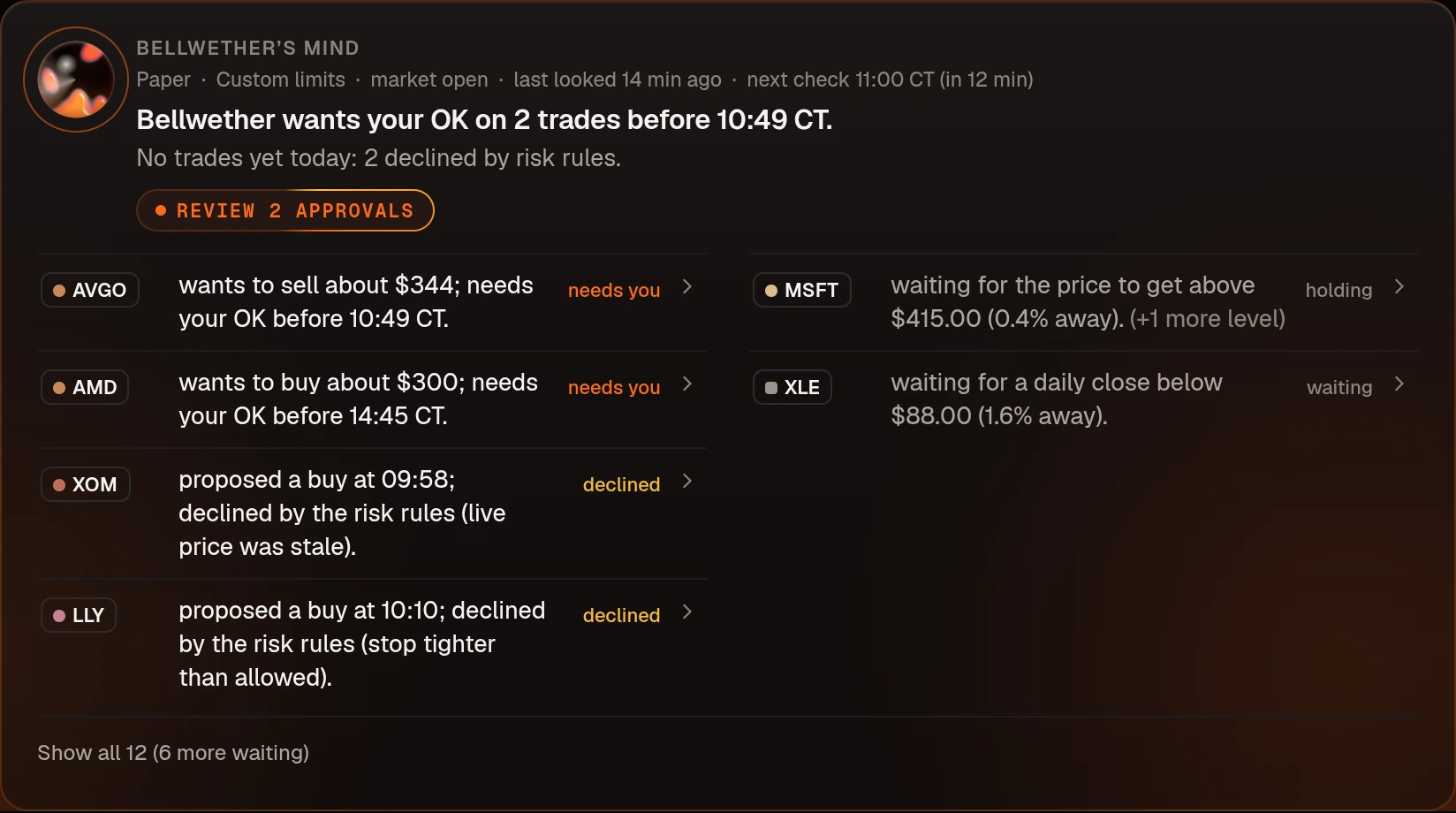
Bellwether’s mindThe Overview card: the PM’s current stance in its own words, what it is watching and how far each level is, what it intends next, and which of your constraints are in play.
Model-written prose is always marked as such, every number is the platform’s own, and anything you might act on links to where it came from.
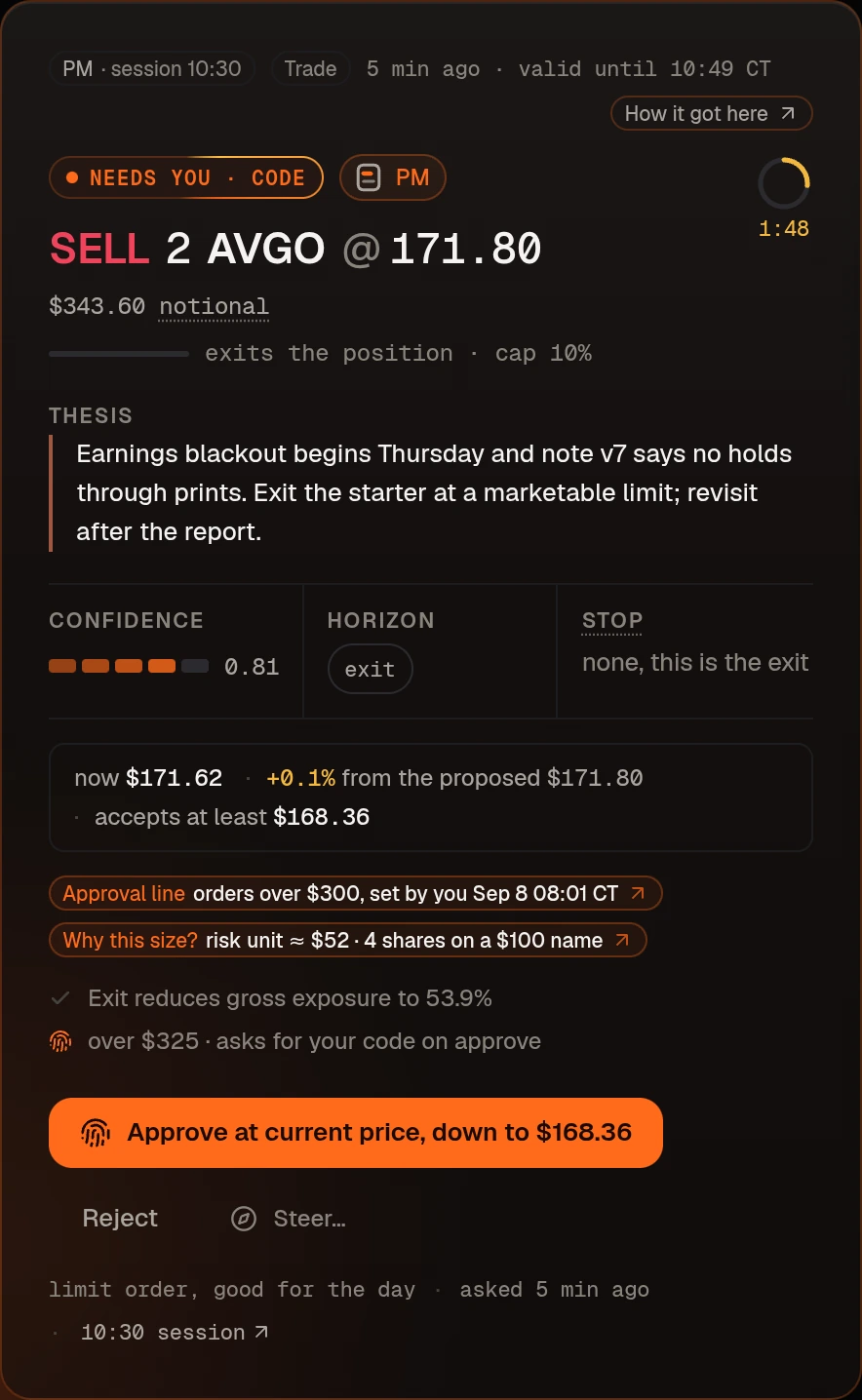
A card in your inboxOne proposal waiting for you: side, size and price, the thesis, confidence and horizon, how the price has moved since it was proposed, where it came from, and Approve or Reject. The countdown is the quote going stale, not pressure.
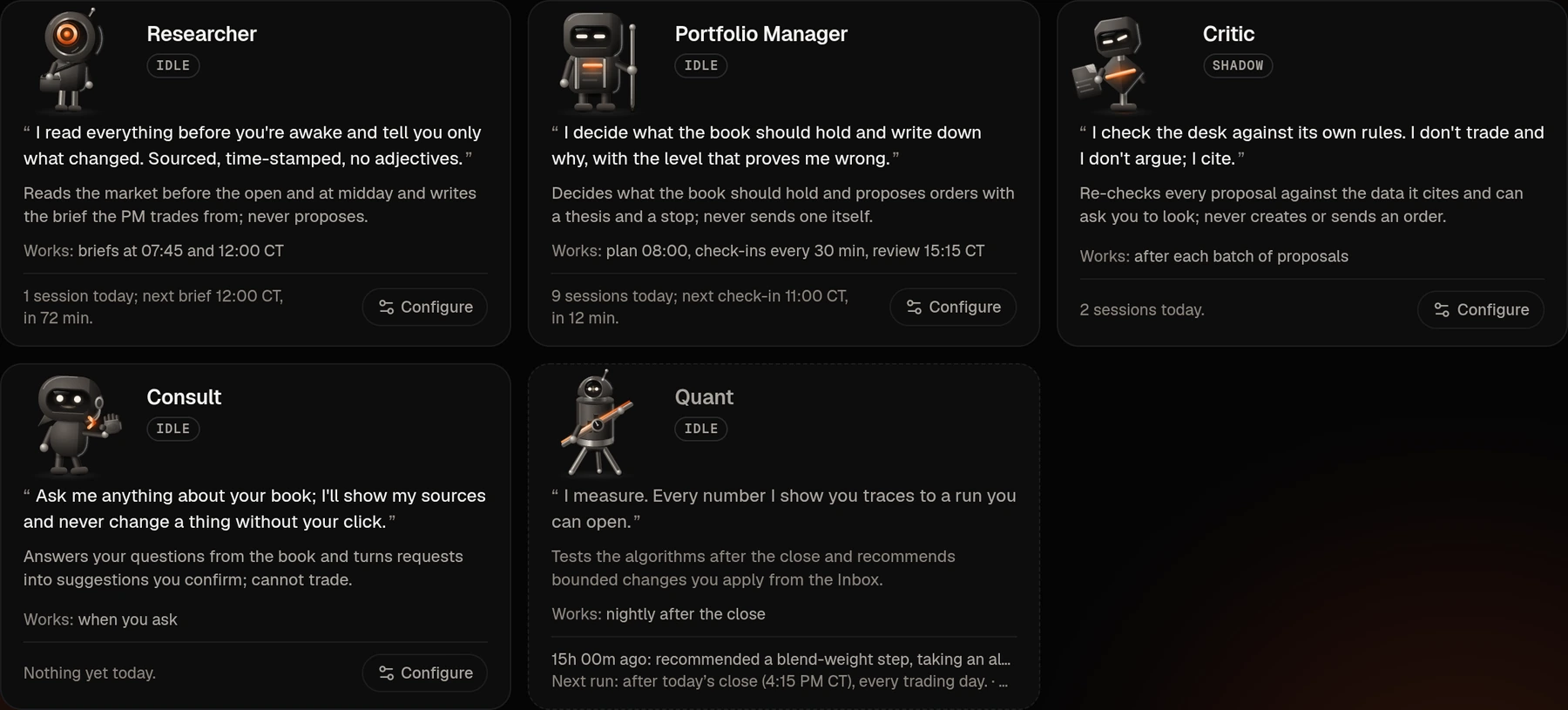
Your deskEach agent as a card: its mark, what it is doing right now, when it last ran and what it handed off, and the way into its sessions, settings, memory and schedule.
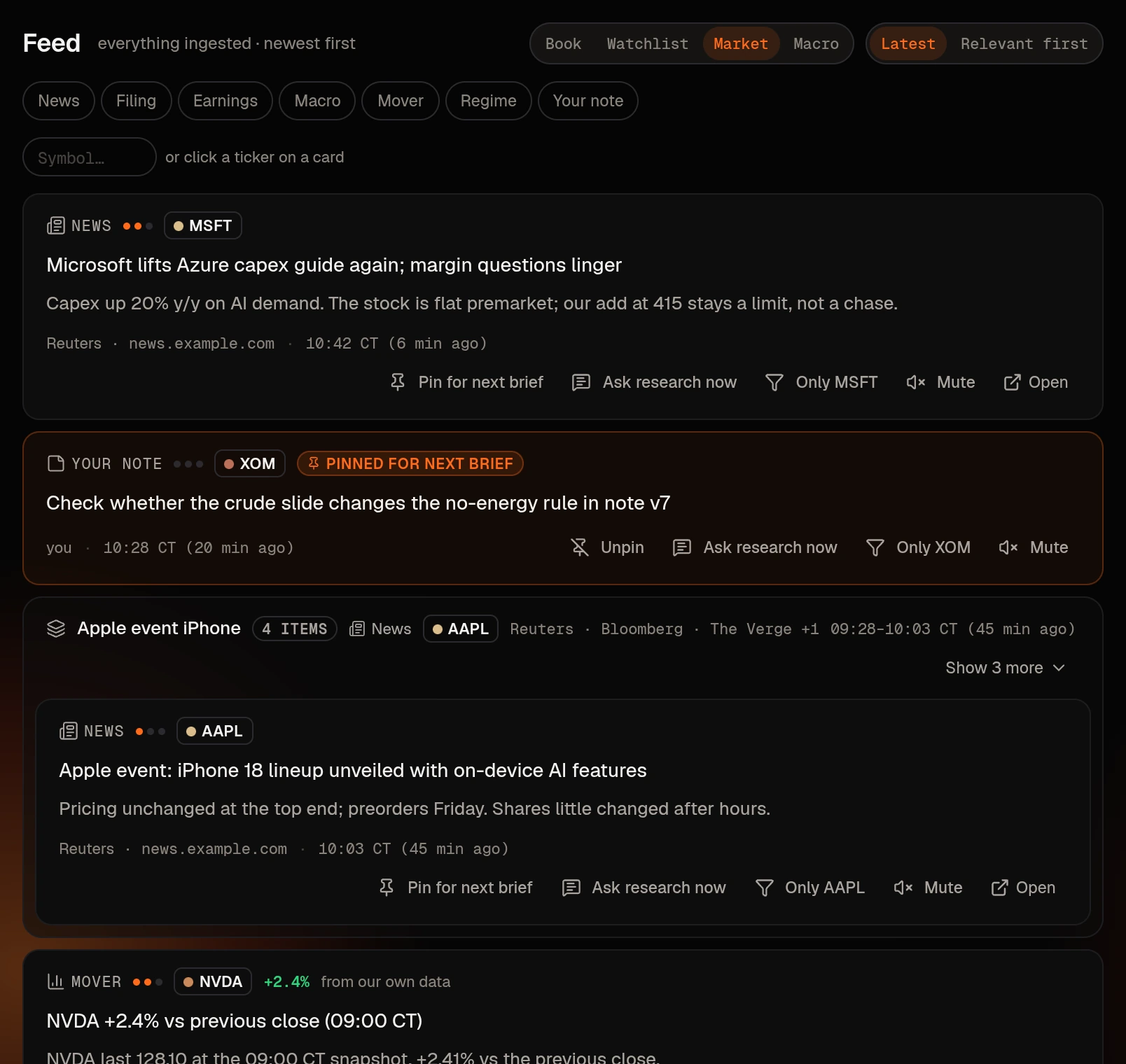
The research feedBriefs and items with citations, filtered to the names you trade, with ‘why this matters for the book’ written out.
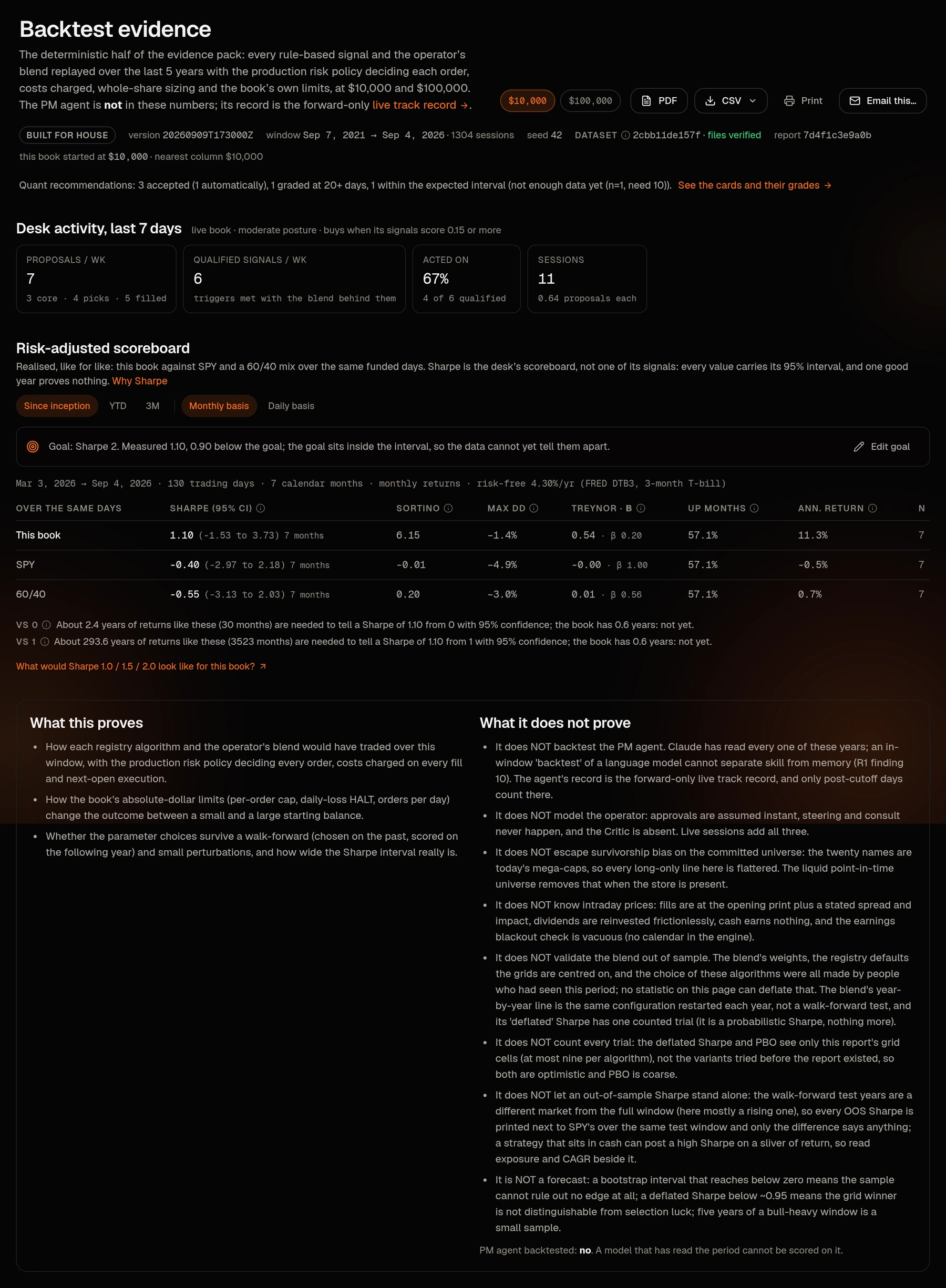
Evidence, not promisesThe top of a strategy’s evidence page: where the report came from, the dataset hash it was run on, and, before a single figure, what the replay proves and the longer list of what it does not.
Built in, not bolted on
Safety by construction
The rules that matter are not instructions to a model. They are code paths that do not exist, limits enforced where the order is sent, and a switch that is always one click away.
Paper first
Every book starts on a paper account: real prices, pretend money. Going live is a deliberate, multi-step change made outside the console after weeks of paper evidence. Never a toggle.
Only the Executor holds keys
No agent has broker credentials, a network tool or a way to write an order. The one component that can trade has no model in it and is covered by tests line for line.
Halts and limits live in code
Daily loss, drawdown, exposure, order size, stale quotes, no trading around the open and close: checked at send time, every time. Loosening a limit asks for your authenticator code and leaves an audit line. Halt is one click from any screen.
Your book is yours alone
Each book is isolated at the database layer: another operator’s agents, data and settings cannot read or touch yours, and a read-only guest sees numbers, never controls.
Nothing moves money
There is no code that can deposit, withdraw or link a bank. Funding happens at your broker, by you. Bellwether never sees bank details.
The checks
Every order, every time: the Executor’s checks in the order they run. The first failure wins and nothing is skipped.
01Paper account matches this desk
02Market open, outside the no-trade window
03Symbol passes the tradability screen
04Buy or sell only (no shorting)
05Limit order, good for today
06Limit price close to the current quote
07Quote is fresh
08Under the largest-order limit
09Position stays under its size limit
10Book stays under its exposure limit
11Under today's order count limit
12Day-trading rule respected
13No earnings in the blackout window
14Daily loss limit not hit
15Drawdown limit not hit
16Not a duplicate of a recent order
17Approval line
20Settled cash covers it
Evidence
How we test, and what a test looks like when it disappoints
Every strategy ships with an evidence page, and the page shows the misses. Here is one: a published pivot method, implemented literally and replayed through the production risk policy.
Backtest · walk-forward replay‘Jim’ pivot method, literal rules, production limits
Max drawdown
10.6%
Sharpe
0.27
Hit rate
41.4%
Avg hold
3.4 days
n = 3,360 fills over 20.7 years (2006–2026), 28 symbols, 5,453 daily sessions; next-open fills with modeled spread and impact; 230 orders rejected and 124 halt days imposed by the same risk policy the live Executor runs.
It lagged simply holding the index through the same limits. We published that, kept the method as one vote among several, and wrote down the question it raises for its author.
Read before believing any number
The universe is today’s large caps: survivorship-biased, and flagged as such on the page.
A replay is not a forecast. Costs, taxes and your own decisions will differ.
The Claude agents are not in this replay; it tests the rules and the risk policy, not the PM’s judgement. Agent sessions are evaluated separately, on days after the model’s training cut-off.
A small desk of Claude agents that research, propose and review trades in US stocks and ETFs, one deterministic program that alone can place an order inside limits you set, and a console where you approve, steer and read everything they wrote.
Does it trade real money?
Not by default. Every book runs on a paper account with real prices. Going live requires weeks of paper evidence and a deliberate change made at deployment time, outside the console; if the book and the deployment ever disagree about which world they are in, the Executor halts rather than guess.
What do I actually control?
The line: an approval threshold above which nothing moves without you, an autonomy level below it, a risk posture, hard limits that only move within code-defined bounds, plain-English guidance the PM must acknowledge, and a Halt button that stops new orders within seconds from any screen.
How do you test it?
Three ways, all published in the console. Rules and the risk policy are replayed walk-forward over twenty years of daily data with costs, and the evidence page lists what the replay does not cover. Agent sessions are run on trading days after the model’s training cut-off and scored against what happened, including how well stated confidence was calibrated. And every live paper day is journaled, reconciled to the cent and reviewed by the Critic. None of this predicts anything; it tells you honestly what happened.
How does it get better over time?
Every session is journaled and every proposal is later scored against what the market actually did. After the close the desk reviews itself: lessons that keep earning their place are kept, the rest are retired, and the Critic’s track record is checked for calibration: when it says 70%, is it right about 70% of the time? Changes to how the desk trades are never silent: each one is versioned, explained, and revertible by you. A dedicated Learning tab that charts adherence and repeated mistakes over time is the next piece to arrive.
What does it trade, and through which broker?
Long-only US-listed stocks and ETFs with day limit orders in regular hours: no shorting, no options, no crypto, no margin, and gross exposure capped below your equity. During the beta it works with a US broker that offers a paper-trading API; you bring your own account and connect it yourself after signing in. The trading key is stored sealed and Bellwether never asks for anything that can move money.
Who can see my book?
You, and anyone you explicitly invite as a read-only guest. Books are isolated from each other at the database layer; the house operator administers logins, not your positions.
How do I get in?
Join the waitlist. We are letting people in slowly while the desk runs on paper; when a seat opens you get a one-time setup link by email, choose a password and enrol an authenticator app. There is no app-store download and nothing to install.
Our goal is the most intelligent trading desk in the world, one that works for you around the clock.
Today it runs on paper money in the open, and we are letting people in a few at a time. Leave your email and we will write when a seat opens.
Built by engineers who work on frontier AI systems for a living.