Consult
The advisor you chat with. It reads your book and live data, drafts typed asks you confirm with one click, answers how-to questions from this help center, and never trades.
- Who it is for
- New to Bellwether
- Reading time
- 11 min read
- Updated
is the orange button in the top bar. It opens a chat with an advisor that can see your positions, limits, , the latest brief and the PM's recent decisions, and can read live quotes and news. It advises, and it turns what you want into typed cards you confirm. It cannot trade and it writes nothing on its own.
- Owns
- Your chat threads and the intent cards it drafts
- Reads
- A built now (account, positions, today's and verdicts, , steering notes, the latest brief, flags), the thread summary, live quotes and news, this help center
- Tools
- The PM's read-only set, the intent tools, three help tools, one search tool over this book's briefs, sessions, proposals and alerts plus symbols and the research feed; no order tool, no broker, shell, file or network access, no other role's transcripts
- Model
- Sonnet 5 by default; Fable 5.1 per message
- Cadence
- On demand: one short session per message, capped at 12 tool turns, $0.75 and 120 seconds
- Change it at
- The Sonnet / Fable toggle under the composer on Consult; the caps are deployment settings
- Hands off to
- You: every card waits for your Confirm. A confirmed card becomes a steering note, a watch item, a queued PM or run, or a setting change
- Judged by
- A 40-question help eval for how-to answers, and the feedback you log when it misses
Where it lives
The drawer opens from any : the top-bar button, the C key, or G then C. The full page is Consult, with your threads on the left; other screens open it with a message already written to start a conversation about one thing, such as a finding.
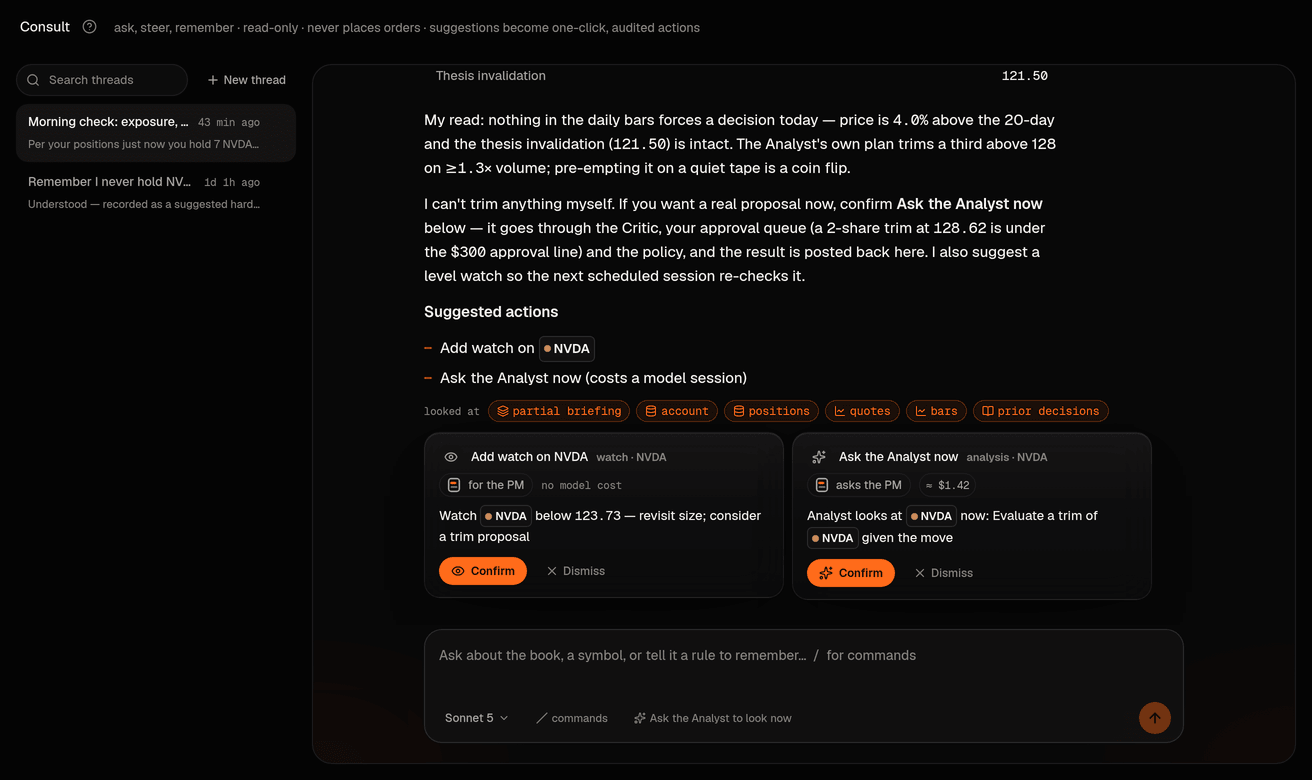
Above the composer are context chips for what you were looking at: the screen, a selected symbol, a proposal, a session or a finding. Drop any chip you do not want sent; a proposal or session becomes a visible "re:" line at the top of your message, so you see exactly what the model receives.
Typing / offers four templates: ask the PM (shown as on screen) to look at a name, research a name, explain why the agent did something, and steer with a rule for every future session. Ask the Analyst to look now beside the composer drafts an analysis card from your draft text without waiting for an answer.
Every turn starts fresh
There is no long-lived process. Each message is one short model session assembled from the database: a state card built by code, a rolling summary of the thread, the last 12 exchanges verbatim, then your message. The summary is why you can come back to a thread days later.
The tools are the PM's read-only set (account, positions, quotes, bars, calendar, news, movers, filings, fundamentals, the research feed, the universe screen, prior decisions, factor scores, regime, , briefs, the and , the journal and memory lookups) plus the intent and help tools below and a platform search that returns the same grouped hits ⌘K shows (see search), always for the book the message is about and never another. The list is the one written in Consult's role spec, and a test keeps the spec, what the session is served and what the recorder allows identical. When a number matters it confirms with a tool rather than quoting the card, and says which calls it made.
Two models
Sonnet is the default: cents per answer, ten to forty seconds. Fable is slower and deeper; pick it per message with the toggle under the composer. There is no schedule: each message is one session, capped at $0.75, 12 tool turns and 120 seconds, sharing the daily model budget with the PM. See Model policy.
Cards you confirm
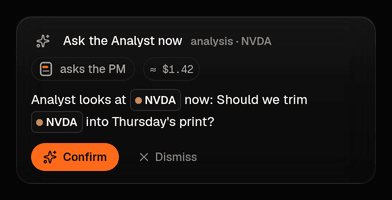
Consult records typed asks with suggest_intent (the older suggest_steering_note, suggest_watch_item and request_adhoc_analysis still work and become the same cards). Each one appears under the reply as a card that says what it will do and what it costs, with Confirm and Dismiss. Nothing is written until you confirm; confirming applies it in the same step and writes one audit line.
- Steer: a preference, rule or question in your voice that should outlive the chat. It becomes a note on Strategy › Guidance that every scheduled PM session must , and the acknowledgement is posted back into the thread. Notes expire within 10 trading days. A (no new buys, a gross cap, a blocklist) also compiles into a rule the checks before every buy and applies at once to buys already resting or waiting (see hard constraints). Its scope follows the card: a whole-book "no new buys" stays whole-book even if you were looking at one symbol when you asked, only a card scoped to one symbol narrows to that symbol, and a blocklist card must name its tickers. A "must avoid" note on a symbol also puts the name on the for the note's lifetime (it comes off when you dismiss the note, or within about 15 minutes of it expiring); a "must reduce to n%" note is recorded as a per-symbol cap the PM must honour, while the Executor keeps enforcing the global position cap. Confirming a hard note, or a "must avoid" or "must reduce" on a symbol, asks for your . See playbook vs steering.
- Watch a level: a symbol, above or below a price, and what to reconsider then. It becomes a watch item the next sessions check against fresh quotes; nothing trades because of it.
- Ask for analysis: when the question amounts to "should we buy or sell". Consult gives its read, then offers a PM run with your question at the top of its prompt. Now queues it immediately (for the next open if the market is closed); next session puts the question in front of the next scheduled session, which must answer it. Any proposal that run makes goes through the Critic, the Inbox and the Executor like a scheduled one, and "Analyst ran …" is posted back into the thread with a link.
- Ask for research: a focused Researcher brief on names or a theme. It lands on Research and "Brief ready …" is posted back into the thread.
- Adjust a setting: , , cadence or an 's mode. The API applies it with exactly the bounds, and step-up of the settings screen; loosening always asks for your code. One exception on this build: a move to Full autonomy cannot be confirmed from a card (it needs the 5-minute critical code, which the card cannot carry); make that change on Strategy › Profile › Autonomy itself.
Guards: the same card confirmed twice within 30 minutes is refused with a pointer to the first; Consult-triggered runs are capped at 6 a day; a run costs a model session and the card shows the estimate. A refusal is final: the card shows the reason at once, one "A confirmed request was not carried out" alert is written under Activity › Alerts, and nothing retries it later behind your back: a capped "look at NVDA now" does not quietly fire tomorrow morning. Ask again when it makes sense. Only a request that failed for a technical reason is retried, up to five times with growing pauses (about eight minutes in all), before it is parked the same way. If you ask Consult to place an order, it says plainly that it cannot and offers one of these paths instead.
Auto-confirm
By default nothing confirms itself. A deployment can list kinds that the Consult worker confirms on its own the moment the card is drafted (a server setting, empty by default); such a card is marked auto, and the audit trail records it as confirmed automatically by Consult rather than by you. Only four kinds can ever be listed: steer, watch a level, ask for research and ask for analysis. A setting change (adjust) is never auto-confirmed, whatever the deployment says.
Even for a listed kind, the worker refuses and leaves the card for you (it stays under the reply with "auto-confirm refused: … (confirm by hand)") when:
- the message was not typed by an owner or operator of the book. A 's chat, or a message with no recorded author, never changes anything unattended;
- the card would need your authenticator code if you confirmed it yourself: a hard constraint, or a "must avoid" / "must reduce" note on a symbol. An Executor rule or a denylist entry is only ever installed by a person with a fresh code;
- it is a steer and there is no text of yours to record. An auto-confirmed steering note carries your own typed words as the note the PM must acknowledge; the model's phrasing is kept on the card as a suggestion only;
- the usual guards apply: a duplicate within 30 minutes, or a seventh Consult-triggered run today.
A refused card is not an error: press Confirm (with your code where it asks) or Dismiss.
Richer replies (planned)
Decided, not in this build yet: Consult will be able to show a small interactive block inside a reply (a picker, a table, a confirm list) chosen from a fixed, versioned registry of console components, never markup or code the model wrote. What you select is validated against the block's declared answer shape and handed back to Consult as its tool result, and both sides are kept in the transcript. Such a block only collects input or displays data; anything it leads to still becomes one of the cards above, with the same confirm and step-up rules. Today every reply is text plus the typed cards.
When it shows instead of tells
Some answers come with a small card under the words: the price you asked about with its change on the day, your positions side by side, a ladder of the levels it just talked through, the shape of the last month, a checklist of what has to be true before it would act, a pointer to the one screen where a setting lives, or a link to the thing already waiting in your Inbox. These are drawn by the console from numbers Consult read with its own tools a moment ago. Consult cannot put buttons, links to the outside, or styling of its own on the page, and a card it gets wrong simply does not appear. A watch card shows one level the desk is waiting on against the last price it has (after hours it says market closed · last … rather than pretending to a live quote); the desk radar lines every armed level up per symbol. The same cards make up the Watching section of Bellwether's mind on the Overview. A card captioned Sketch · not an order is exactly that: a picture of what a proposal could look like, never something queued; if you want the PM to actually look, confirm the card beneath it.
How-to questions
Three read-only help tools (help_search, help_open and where_is) answer a product question ("where do I change autonomy?") only from the help center, with numbered source chips under the answer that link to the article or the screen. where_is maps a setting or a verb to the one place it is edited. A citation the tools did not actually return is dropped before the answer is stored.
If the help center has nothing on your question, Consult says so and offers to log it as feedback (Review › Feedback). It does not guess at how the console works.
What it will not do
- Place, propose, size, price or approve an order. No tool it holds can, and it has no broker credentials, shell, file or network access.
- Write a note, watch item, job or setting by itself. Cards wait for your click, except the kinds a deployment has chosen to auto-confirm, and those never include a setting change or anything that needs your code.
- Read other roles' transcripts.
Owners, operators and reviewers can ask; a Viewer-role login can read threads but not post. Only the owner and operators can confirm a card. Someone looking at your book through a read-only share is different again: see the next section.
Asking about a book you only view
While you look at a book that was shared with you read-only (the lock in the book switcher, the "Viewing … read-only" bar), Consult still opens and you may ask about that book, in threads of your own. Your thread list there holds only the threads you started on that book; the book's own conversations and Consult's transcripts are not shown to you, and a thread you open is marked "‹you› · visitor" in the owner's list. The composer says "Ask about ‹book› (read-only: answers explain, they never change the book)", offers only the explain and research templates, and has no Ask the Analyst to look now. Answers come from the read tools and the default model (the Fable toggle is ignored), and never carry a card: no steering note, watch item, run or setting can come out of a visitor's question, confirmed or not. You get 12 questions per book per day, counted against that book's model budget; after that the composer answers "That's today's questions for this book" until tomorrow. The owner can read your thread but cannot post into it (their composer explains why); they answer in a thread of their own. On a book you run through a membership none of this applies: Consult behaves exactly as on your home book.
How it is judged
On its how-to answers: a fixed set of 40 operator questions must cite the right article and route, and the run fails red under 38. On everything else, by you: the feedback you log from a miss is read the next morning.
Failure modes you might see
- A polite refusal: the daily model budget is spent; sessions resume tomorrow.
- Timed out: an answer that needs more than 120 seconds or 12 tool turns ends with an error reply; ask a narrower question or switch models.
- Duplicate / capped: a second identical confirm within 30 minutes, or a seventh triggered run today, is refused with the reason.
- Queued for the open: an analysis asked for after hours waits for the next session open; the card says when.
- "The help has nothing on that": an honest miss, with an offer to log it.