The trading day
Hour by hour in Central time: the brief, the premarket session, the order window, the check-ins, the close, the journal and the day report, plus what runs when the market is shut.
- Who it is for
- New to Bellwether
- Reading time
- 5 min read
- Updated
Bellwether keeps Central time. Nothing runs on weekends or exchange holidays, and on early-close days the afternoon stops move up to fit a 12:00 close. Here is a normal trading day.
- 07:45BriefResearcher
- 12:00BriefResearcher
- 08:00Premarket session (may start late until 09:30)PM
- 08:30Market opensExecutor
- 08:45Order window opensExecutor
- 09:00Intraday check-ins · every 60 min until 14:30PM
- 14:30Intraday check-ins · last check-inPM
- 14:48Close-confirmation passPM
- 14:45Nothing new is sentExecutor
- 15:00Market closesExecutor
- 15:15Post-market journalPM
- 15:45Day reportScheduler
Hour by hour
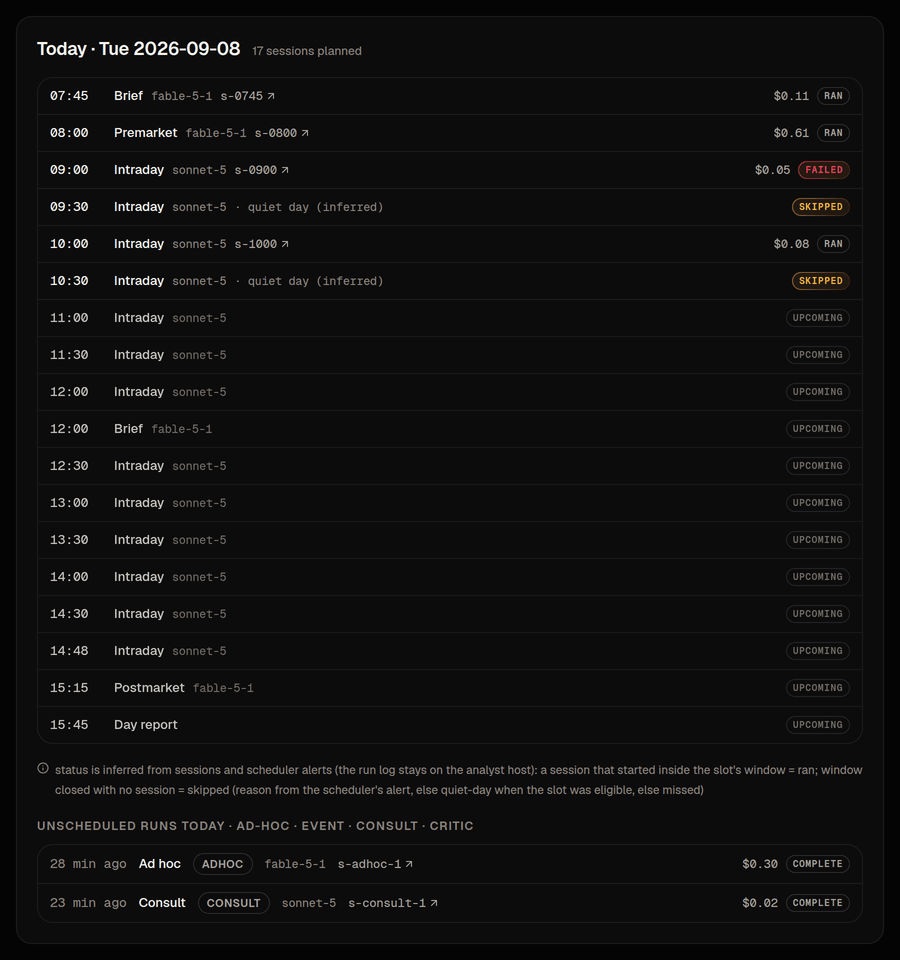
Each stop has a where its output lands. The 07:45 and 12:00 briefs appear on Research: what moved overnight and why it matters to what you hold, then what changed since the open. The 08:00 premarket session may start late but never after 09:30; it shows on Agent as a new chip with 0 to 3 , which cannot move until the opens at 08:45, when anything over your threshold lands in the Inbox. Check-ins from 09:00 to 14:30 add more chips and the occasional new card; at 14:30 unanswered premarket cards move to Decided today as expired. After 14:45 nothing new goes to the broker. At 14:48 one more intraday session runs, the close-confirmation pass (below): it judges the day's "confirm on the close" conditions on the nearly finished daily bar and parks any resulting order for tomorrow's window. At the 15:00 close the broker cancels any unfilled . The 15:15 post-market session writes a journal entry and no proposals, and at 15:45 the is built on Review: one page on the day, costs and included.
On a half day (12:00 CT close) there is only the 07:45 brief, check-ins stop at 11:30, nothing new is sent after 11:45, the close-confirmation pass runs at 11:48, the post-market session runs at 12:15 and the day report at 12:45.
The order window
The never trades in the first or last NO_TRADE_MINUTES of the session (15 by default, on Risk › Limits; it can be raised, never lowered below 5). So the 08:00 session writes ideas the Executor may not act on until 08:45. It does not reject them; it holds them until the window opens, then runs the checks on a fresh quote.
Check-ins and quiet days
Between 09:00 and 14:30 the Scheduler gives the PM (shown as on screen) a short session every 60 minutes on the Moderate , every 120 on Conservative, every 30 on Aggressive. You can set the interval and the intraday model yourself on Desk › Portfolio Manager › Configure; the premarket and postmarket models are deployment settings, shown there for reference.
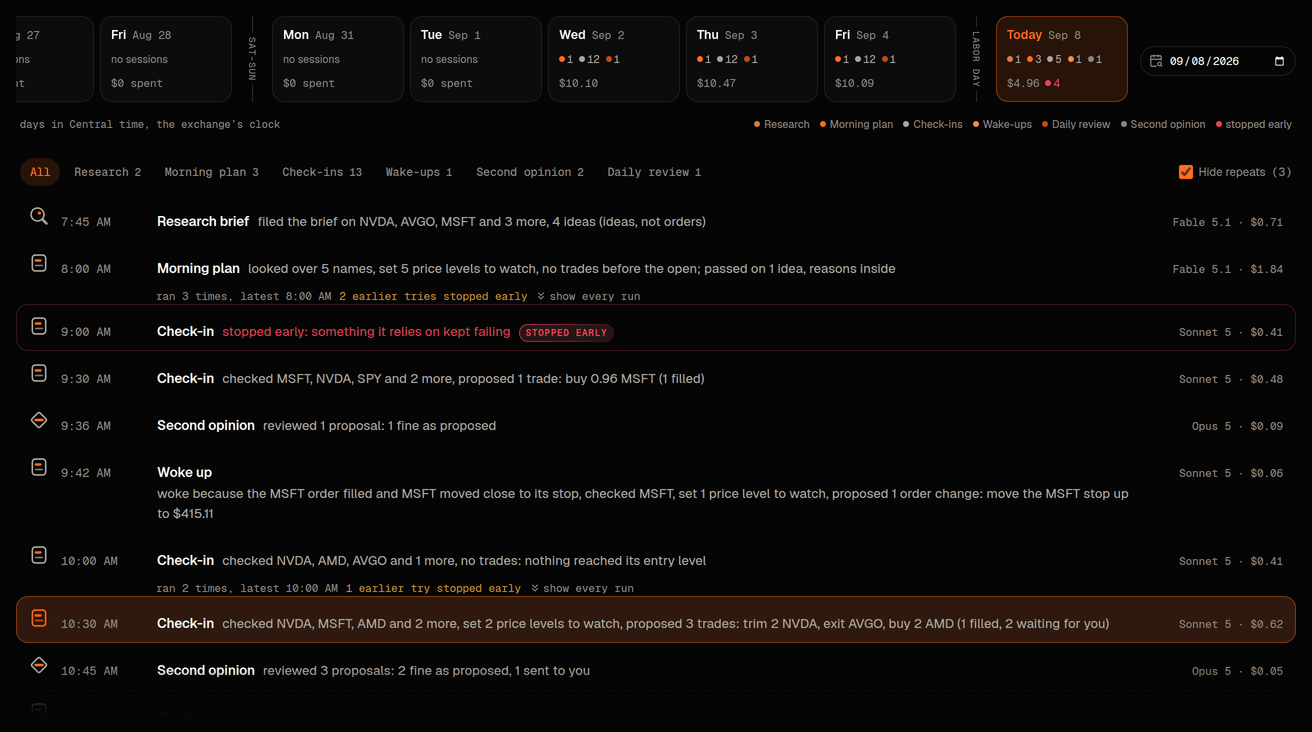
After the day's first check-in, a check-in is skipped when the day is quiet (the 14:48 pass never is): nothing has filled since the last one, no position is near its stop, target or , no card is waiting for you, no is waiting to be , no new brief has landed, the regime note is unchanged, and the previous check-in proposed nothing. The chip on Agent reads skipped and no alert is raised; an empty stretch on the timeline is normal, not a fault. Any doubt (a price it cannot read) not quiet, so the session runs.
The 14:48 close-confirmation pass
Many of the PM's triggers read "only on a daily close above …". Waiting for tomorrow's premarket to judge them cost a day every time, so whenever intraday sessions are on the Scheduler adds one fixed run at 14:48 CT (11:48 on a half day), twelve minutes before the close, when the daily bar is all but formed. It shows on Agent as an ordinary intraday chip at 14:48 and is always the last one of the day. In it the PM judges every close condition now (confirmed, failed or unresolved, "judged at 14:48 CT as a proxy for the close") and records the verdicts in its handoff.
Today's order window shut at 14:45, so anything this session wants to buy or sell is parked for the next session, stamped exactly as tomorrow's premarket session would stamp it: orderable from 08:45 CT tomorrow, 14:30 CT tomorrow, priced the premarket way (a peg to the open with a cap). Above your it is a card in the Inbox you can approve or reject all evening; below it, it waits as deferred and the Executor runs all on a fresh quote when the window opens. Stop and target changes and cancels from the pass are not parked; they apply at once. If the overnight tape breaks the , the 08:00 premarket session can withdraw a parked order before 08:45 (the proposal then closes as rejected with a "withdrawn by analyst" note and the reason, nothing having reached the broker); otherwise it leaves it alone and does not propose the same name twice.
Proposal windows
Every proposal carries an order window: a not_before and an expires_at.
- Premarket ideas become eligible at 08:45 and stay valid until 14:30 CT, 30 minutes before a regular close.
- Intraday ideas are eligible at once and stay valid until 14:45 CT, 15 minutes before the close, however late in the day they were written.
- The PM may shorten a window, never lengthen it. A proposal that says it is only good for 45 minutes expires after 45 minutes.
- Nothing written for today waits overnight. An idea that has not been sent by the end of its window is marked expired and the PM is told, so it can re-propose at a fresh price if the thesis still holds. The one deliberate exception is an order from the 14:48 pass, which is written for tomorrow's window in the first place.
A card stays approvable for its whole window; there is no separate short fuse. When you approve, the Executor re-quotes, re-runs the full risk policy on current data, and places the order inside the cap the PM set. If the price has run past that cap, nothing is placed and the PM re-proposes. Thesis windows has the details.
What runs when the market is closed
Nothing trades. There is no plan on a weekend or a holiday, so no scheduled session runs and no order can be sent.
What still works: Consult answers questions about your book at any hour, and an analysis you ask it to queue while the market is shut waits for the next open. Proposals cannot outlive their window; apart from the 14:48 pass's orders, which are stamped for the next session on purpose, the PM re-proposes in the morning if an idea still holds. Reading, steering, changing limits and reviewing reports work whenever you like. The reviews each session right after it runs, so its findings on Agent are waiting for the PM, and for you, before the next morning.