The Quant
The desk's systematic analyst. It runs the algorithm bench with deterministic tools after the close and proposes blend, sleeve and parameter changes you apply from the Inbox (or, on Auto, bounded blend changes it applies itself).
- Who it is for
- New to Bellwether
- Reading time
- 3 min read
- Updated
The Quant is the desk's systematic : the role that keeps score on the , tests newcomers against the , and proposes changes to how much each one counts. It measures; it never trades.
- Owns
- to change the , promote or retire an algorithm, adjust a sleeve target, tune a parameter, advice
- Reads
- Realized outcomes and attribution, past proposals and your decisions on them, the algorithm registry, the tradable universe
- Tools
- The deterministic quant engine and a few read-only readers; no news, briefs, chat, order or config tools
- Model
- Opus 5 (the Quant model setting), $1.00 and 24 turns per run
- Cadence
- Nightly after the (16:15 CT; 13:15 on a half day), plus Run now
- Change it at
- Desk › Quant: on/off· Desk › Quant, Manual / Auto· Strategy › Profile › Autonomy › Tuning (Off / Recommend / Auto), scope· Desk › Quant › Scope, model· Desk › Quant › Model, cadence· Desk › Quant › Cadence
- Hands off to
- You, as Desk suggestion cards in the Inbox; on Auto, a bounded code path in the console service at the next PM session boundary
- Judged by
- Whether applied changes improved realized attribution; how often you overrule it (shown on its card)
What it does
A model session whose only tools are the deterministic quant engine and a few read-only readers. It gets no news, no briefs, no chat, no transcripts. Its output is a typed report with proposals of a few fixed kinds: change a weight in the blend· Algorithms, promote an algorithm from the bench, retire one, adjust a sleeve target, tune a parameter, or advise on posture. Each proposal carries the engine's numbers and a short note in the Quant's own words, labelled as such.
Tools
Engine functions are plain code: walk-forward tests, attribution, overrule scoring, blend fitting, sleeve drift, bench-and-retire tests, . The readers return outcomes, past proposals, the registry and the universe. Nothing proposes an order or writes config; the Quant's database role cannot write configuration at all.
Model, cadence and how to change them
Opus 5 by default, nightly after the day report. Both are settings on the Quant desk card on Desk › Quant, the same owner route as the rest of the desk (Model policy).
Manual and auto
- Manual (the default): each proposal becomes an Apply / Dismiss card in the Inbox under Desk suggestions. You are the config writer; the Quant only suggests. Undecided cards expire after 24 hours.
- Auto ( + typed AUTO): bounded blend proposals are applied at the next PM session boundary by the console service, not by the model. It re-reads the values the proposal was based on and, if anything moved since, aborts to a manual card instead of applying. It never applies a proposal older than 24 hours, never moves one algorithm more than 0.10 or a run more than 0.25, writes the change and its audit row together, notifies you, and keeps the change revertible for 7 days.
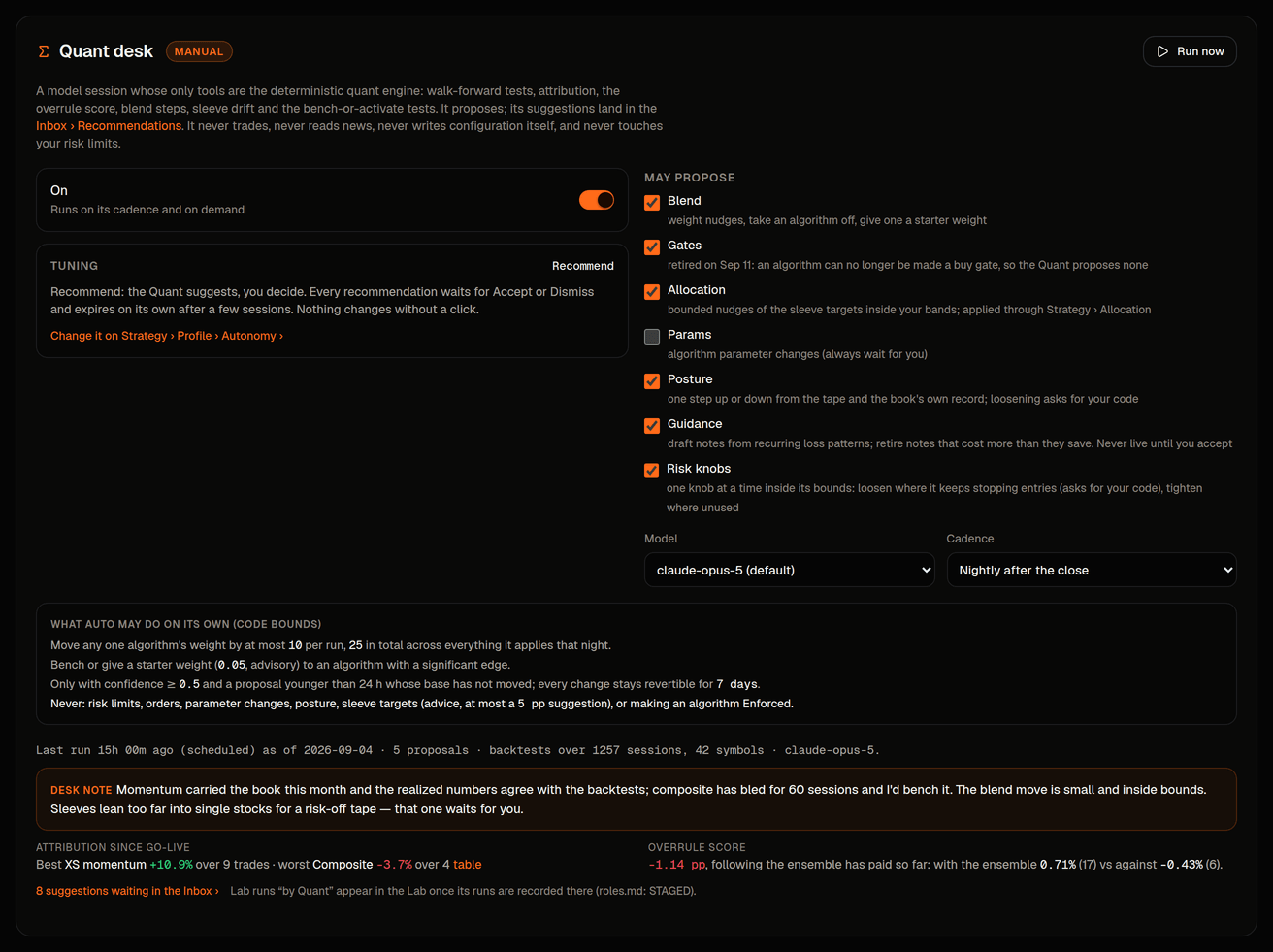
Read The Quant desk for the card, the Inbox flow and the bounds in detail.
What it never touches
The risk limits on Risk › Limits are Layer 1: the numbers the enforces. The Quant never proposes a change to them, never sets an algorithm to Required· Algorithms › On / Off and weight, and never proposes a trade. Posture is advice to the PM, and the Quant's view of posture is advice too: it deep-links to where posture is edited and changes nothing itself.
Failure modes you might see
An Auto proposal comes back as a manual card marked stale (the blend moved under it); a card says overdue because the applier is not running (the next run raises an alert and the card expires rather than applying late); a run fails or times out (an alert, no proposals, yesterday's cards untouched).