Posture vs autonomy
Posture is how hard the desk pushes. Autonomy is whether it asks you first. Every limit applies in every mode; the mode only decides who clicks.
- Who it is for
- New to Bellwether
- Reading time
- 2 min read
- Updated
Two dials on Strategy › Profile shape almost everything the desk does. They sound alike and do different jobs.
Posture: how hard it pushes
sets the fence and the temperament. It decides how big one position may get, how much of the book may be invested, the largest single order, how many orders a day, the and halts, how readily the desk acts on a , how much it risks on each idea, and how much sits in the core index sleeve. Preservation, Conservative, Moderate and Aggressive are four presets of all of that at once; fine-tuning limit by limit lives on Risk › Limits.
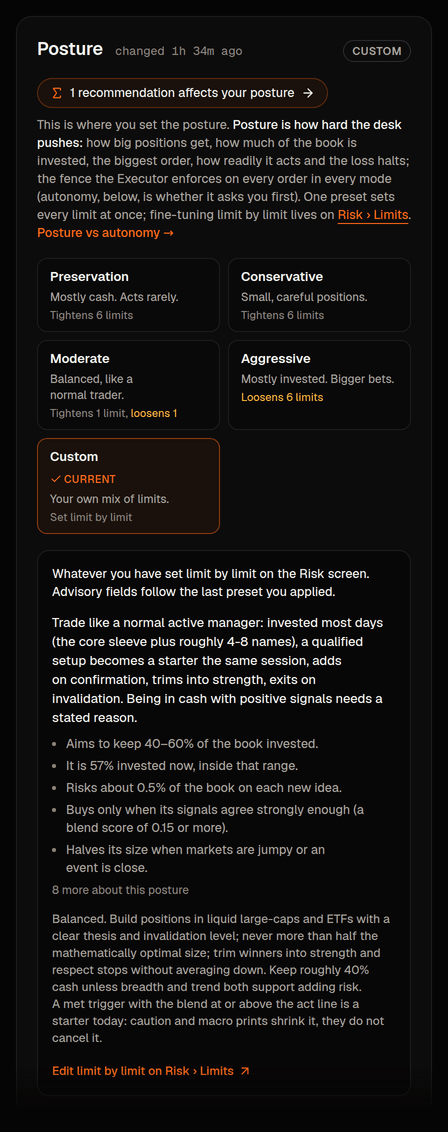
The enforces those limits on every order, in every mode. An order that breaks a limit is refused. Nobody is asked about it, and no setting sends it anyway.
Autonomy: whether it asks you first
Autonomy changes nothing about what the desk is allowed to do or how big it trades. It decides one thing: when an order has already passed every check, does it wait for your tap or go straight to the broker?
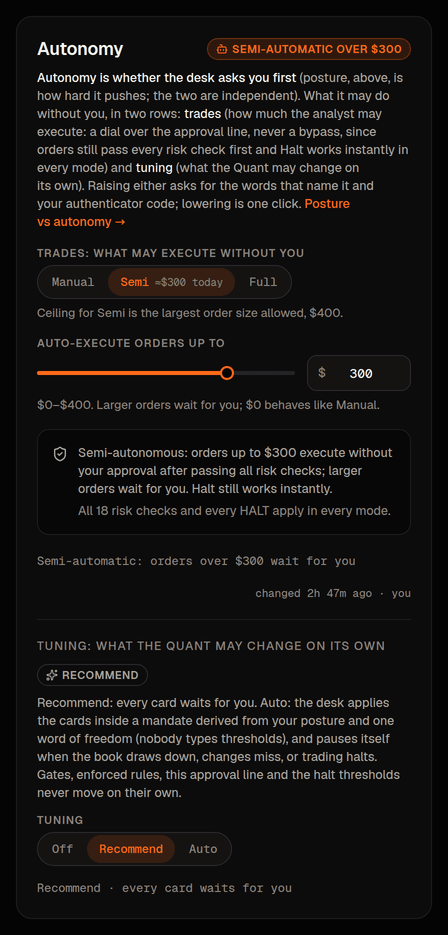
- Manual. Every passing order waits for you in Inbox.
- Semi-automatic. You set a dollar line. Passing orders at or under the line go on their own; bigger ones wait for you.
- Full. Nothing waits. Every passing order goes. You are notified of each fill, everything is on Activity, and in the top bar stops it instantly.
You set it on Strategy › Profile › Autonomy, and only there. Risk and Inbox show the current mode as a chip that links back.
The example that makes it click
Say your posture caps a single order at $1,000 and the desk wants to place three orders that pass every other check: one for $400, one for $900, one for $1,200.
| $400 order | $900 order | $1,200 order | |
|---|---|---|---|
| Manual | waits for you | waits for you | refused (over the cap) |
| Semi, line at $500 | goes on its own | waits for you | refused (over the cap) |
| Full | goes on its own | goes on its own | refused (over the cap) |
The $1,200 order is refused in all three rows: that is the posture at work. The only column that changes between the rows is who clicks: that is autonomy at work. Semi is simply "Full below the line, Manual above it".
They are independent
Every combination is sensible for someone:
- Aggressive posture, Manual autonomy. The desk swings big and often, and you approve each order. Good while you are getting to know a strategy.
- Conservative posture, Full autonomy. Small, careful positions, sent without asking. Good for "set it and leave it".
- Aggressive posture, Full autonomy. Hands off and pushing hard. The posture's limits and the loss halts are the only brakes, which is why they matter most here.
- Preservation, any autonomy. Mostly cash; there is little to approve either way.
If you remember one line: posture is how hard it pushes, autonomy is whether it asks first.