Notifications
What Bellwether tells you about (approvals, fills, halts, briefs, the day report, sign-ins), by email, phone notification or text, with quiet hours, a daily digest and a delivery log, and why nothing is ever approved from a notification.
- Who it is for
- Owners & operators
- Reading time
- 5 min read
- Updated
Bellwether tells you when an order needs you, what became of it, and when something about your money or your account changed; the rest waits in the console. A notification only ever points you at a . Approving, resuming or loosening happens in the console, signed in, and often after a fresh .
What it can tell you about
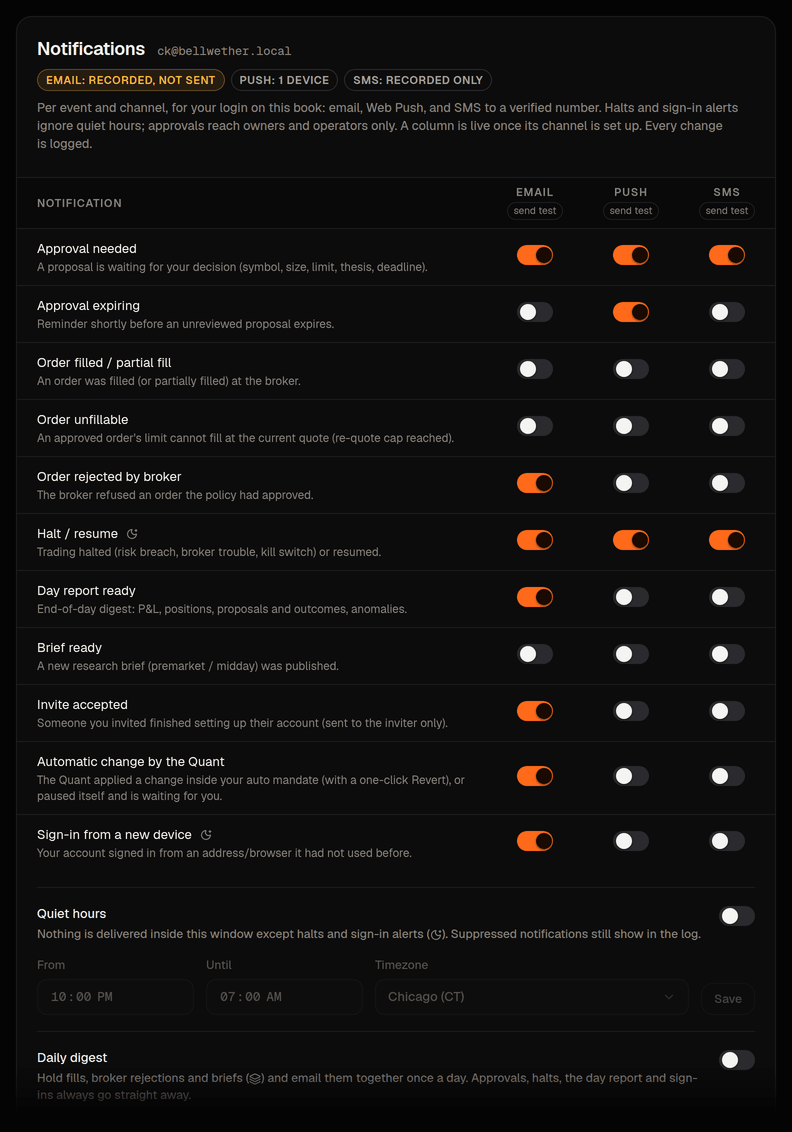
Every notification is about one book and reaches only the people who sign in to that book. Each kind has a default; you change yours per channel on Settings › Notifications.
| Kind | Sent when | On by default (email) | Opens |
|---|---|---|---|
| Approval needed | A above your line starts waiting for you; the message carries symbol, size, limit, the , the deadline and the most a buy will pay after the re-quote | yes, owner and operator | Inbox |
| Approval expiring | Shortly before an unreviewed card runs out (15 minutes before, or half its window if that is shorter) | no | Inbox |
| Order filled / partial fill | The broker filled an order, fully or partly | no; can go into the daily digest | Activity |
| Order unfillable | You approved, but the fresh quote was already past the cap, so nothing was placed | yes | Inbox |
| Order rejected by broker | The broker refused an order the policy had passed | no; can go into the daily digest | Activity |
| / resume | Trading was halted (a risk rule, broker trouble, the kill switch) or resumed | yes, and it ignores quiet hours | Risk |
| ready | The end-of-day report is written | no | Review |
| Brief ready | The published a premarket or midday brief | no; can go into the daily digest | Research |
| Invite accepted | Someone you invited finished setting up; sent to the inviter only | yes | Settings |
| Sign-in from a new device | Your account signed in from an address and browser it had never used | yes, for every role, and it ignores quiet hours | Settings |
The three approval kinds only ever go to people who can act on them (owners and operators), whatever a viewer's switches say. Things about the platform rather than your book (a failed session, the model budget, a finding) are not notifications: they are alerts under Activity › Alerts, and on a deployment with a Slack webhook the operator's channel gets a line for each.
Three channels
- Email goes through the deployment's mail transport. With the default transport, outbox, nothing leaves the machine: every message is written to a table the owner reads from the account menu under Outbox (each invite or reset link has a Copy button), which is how invites and resets work before a mail provider is set up. With Resend configured the same messages are delivered and a copy stays in the Outbox as the record, one-time tokens redacted. The badge at the top of the Outbox dialog says which is in force ("not sending · outbox only" or "sending via resend"). A broken transport never stops trading: the message stays queued, is retried with a back-off (30 seconds up to 2 hours) and then marked failed in the log.
- Phone notifications (web push) are per device. On Settings › Notifications press Enable on this device: the browser asks permission, the device appears in the list with when it last received something, and you can remove it again. On an iPhone add Bellwether to your Home Screen first (Share, then Add to Home Screen) and enable it from that app; Android and desktop browsers ask directly. If the server has no push keys the card says so and the button stays off. A notification opens the screen it is about and nothing else; there is no Approve on it, by design.
- Text messages go to one verified number per person: enter it, receive a six-digit code, confirm. A text is one short line (what happened, symbol, size, price, a link), never a thesis, an address or a secret, and it is rate-limited per hour. Replying STOP at the carrier ends texts until you verify again.
Push and text are off for every kind until you switch them on; a column only comes alive once its channel is set up (a subscribed device, a verified number).
Quiet hours and the daily digest
Quiet hours are a local window in your own time zone (it may wrap midnight). Inside it, notifications are suppressed, not held: a ten-minute approval is worthless at 07:00, and the log still shows what was skipped and why. Halts and new-device sign-ins ignore quiet hours.
The daily digest collects the digestible kinds (fills, broker rejections, briefs) into one email at the local time you pick instead of one mail each; everything else is still sent as it happens.
The delivery log
The bottom of Settings › Notifications lists what was sent to you, on which channel, when, and what was suppressed with the reason (duplicate within the kind's window, quiet hours, no device, no verified number, rate limit). send test under each channel heading sends one message on that channel so you can see the path work before it matters. The log is the record; a phone that never buzzed is a row here with a reason.
The approval email in detail
When the moves a proposal to awaiting approval, the owner and operator accounts of that book get one mail each (subject: the order in a line plus how long it stays valid; body: the thesis, the valid-until time and the cap the re-quote will honour). When the deployment knows its own public address the mail carries an Open the Inbox link; it never carries an Approve button. A card that is still unsent 45 minutes later is not mailed at all: it would arrive stale. If the price has moved past the cap by the time you approve, Order unfillable follows and the PM (shown as on screen) re-proposes on its next session if the thesis still holds.
Where to change each
- Which kinds reach you on which channel, quiet hours, the digest time, your phone number and your devices: Settings › Notifications. It is per person and per book; nobody else's switches change what you get.
- The mail transport (outbox or Resend), the push keys and the text provider: deployment settings the operator makes once; the card shows which are configured.
- Slack: the deployment's operator webhook for platform alerts, not a personal channel; no console switch.
- You cannot silence a halt or a new-device sign-in, and you cannot approve, resume or loosen anything from a message.