What Bellwether is (and isn't)
A desk of Claude agents that research, propose and argue, a plain program that alone touches the broker, and you in charge. Paper money until you say otherwise; it never moves money.
- Who it is for
- New to Bellwether
- Reading time
- 4 min read
- Updated
A brokerage app gives you a button. Bellwether gives you a desk: a small team of Claude agents that do the reading, the arguing and the writing-up, and one plain program that does the trading. The two halves are kept deliberately apart.
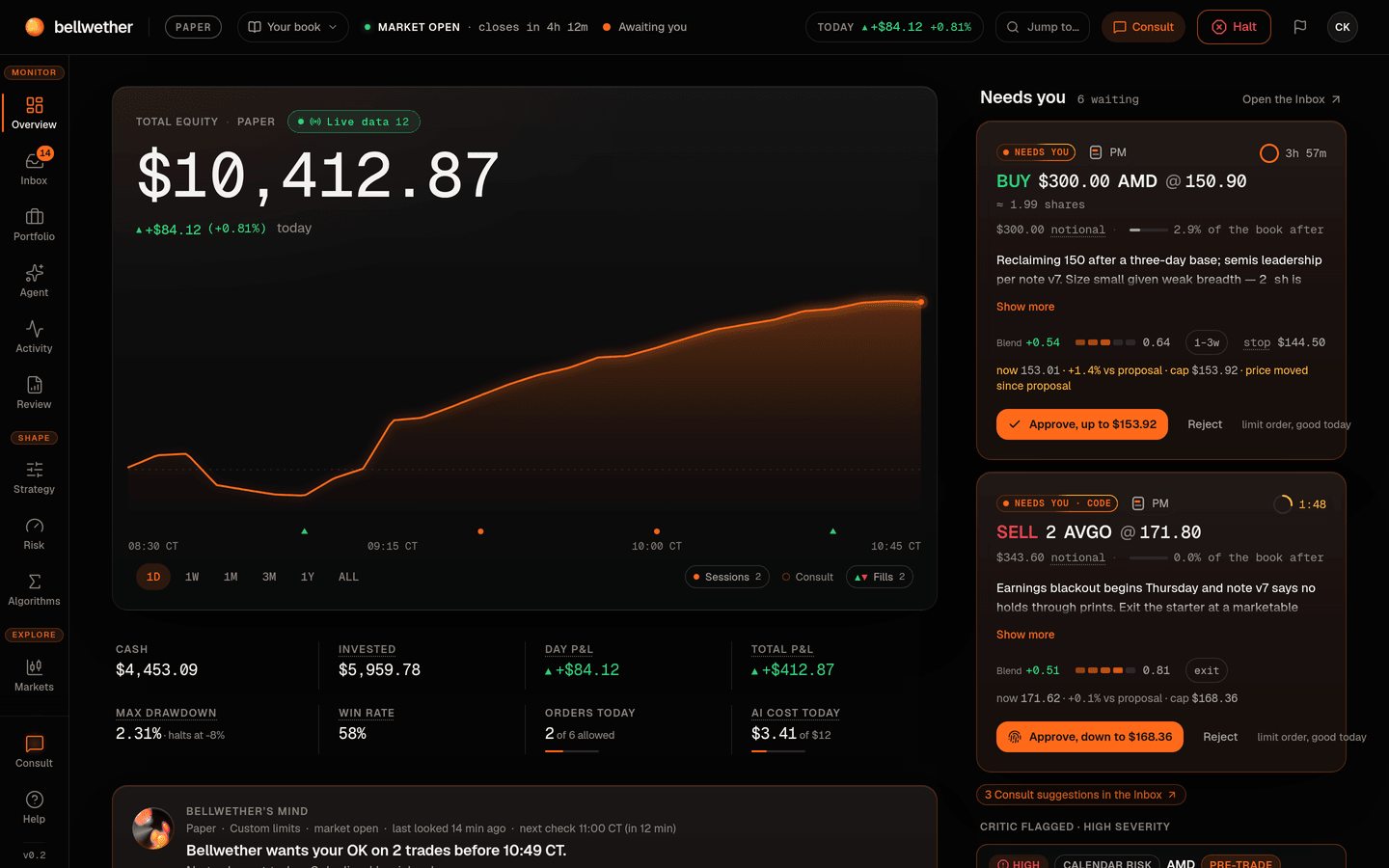
Claude proposes. Code disposes. Every safety rule that matters lives in the , not in a prompt.
A desk, not a button
Every trading morning the reads the tape, the filings and the news and writes you a cited brief. The PM (shown as on ) turns that into trade the way a professional desk writes a ticket: a with the evidence it rests on, the votes, a size worked out against your limits, a stop, an ("wrong if below") and a horizon. The reviews every session and gives each new position a fast pre-trade look before the Executor sees it; the PM has to answer its findings at the next session.
None of them can trade. The Executor is ordinary, tested Python with no model inside. It is the only part of Bellwether that holds broker keys, and it runs every proposal through the same , holds anything over your for you, and only then sends one day . It cannot be talked out of your limits, by you or by the PM: limits move only within code-defined bounds, loosening one asks for your , and every change leaves an audit line.
Everything is written down. Each session is journaled with its reasoning on Agent, proposals are scored against what actually happened, and the findings feed the next session, so the system is accountable rather than magical. The audit trail on Activity shows every change, by whom, when.
Who does what
| Role | What it does | Model? |
|---|---|---|
| Researcher | Writes the 07:45 and 12:00 CT briefs with citations | yes |
| PM (Analyst on screen) | Proposes, modifies and closes positions with a thesis and a stop; keeps a journal | yes |
| Critic | Reviews every session and pre-checks new positions; its findings must be answered next session | yes |
| Answers your questions and turns requests into intent cards you confirm | yes | |
| Executor | Enforces every rule, places and cancels orders, halts. Holds the keys | no |
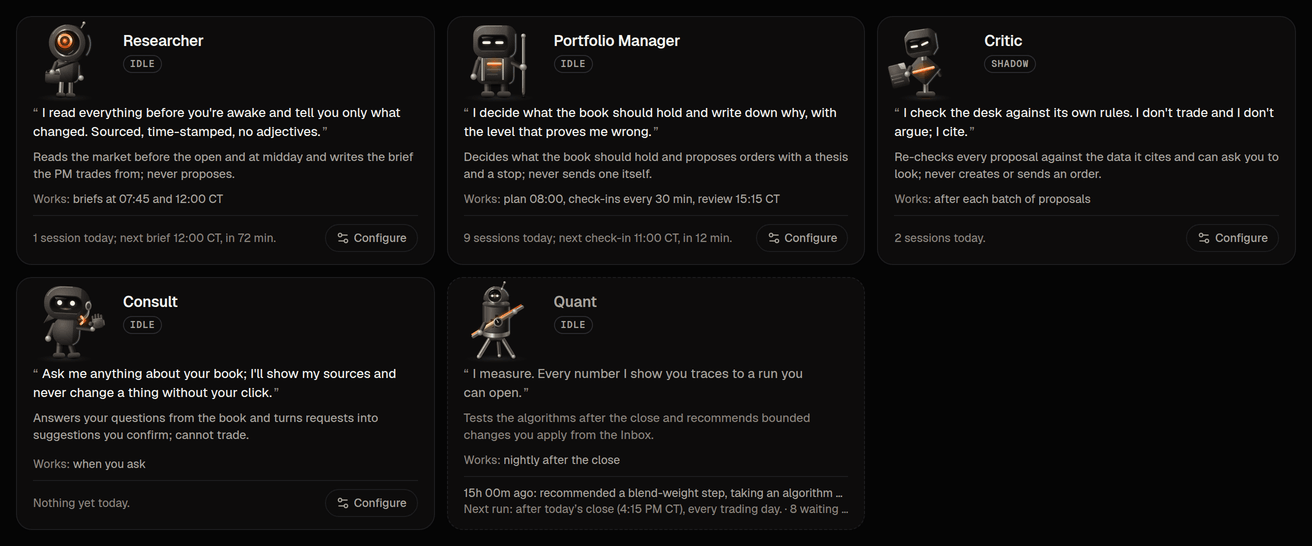
Meet your desk has a page on each of them.
What it never does
- It never moves money. There is no code that can deposit, withdraw or link a bank. Funding happens at the broker, by you, in the broker's own app; Bellwether never sees bank details.
- It never shorts, never buys options or crypto, never uses margin. Long-only US-listed stocks and ETFs, day limit orders, regular hours; is capped below your equity (60% by default).
- It never trades in the first or last 15 minutes of the session (
NO_TRADE_MINUTES), never on a quote older than 30 seconds, never past your ($150 by default) or (8%) lines. Those two trading on their own, and a halt never clears itself. - It never skips you. Above your approval threshold nothing moves until you say yes in the Inbox, and the Halt button in the top bar stops all new orders within about five seconds, from any screen, without asking for a code.
What it is not
- Not a black-box robo-advisor. You see every thesis and the counter-argument attached to it, and you can steer in plain English.
- Not a service. It manages the position after entry, with the stop it proposed, and it owns its mistakes in the journal and the .
- Not a chat bot that trades. Consult can answer anything about your book and suggest a , a or a piece of research for you to confirm, but it has no trade tool. A request that implies a trade goes through the PM, the Critic and the Executor like any other idea.
Paper first, always
Your book runs on a : real prices, pretend money. The PAPER pill in the top bar tells you which world you are in. Going live is a ceremony, not a click: at least 20 trading days of paper evidence, then a change the operator makes at deployment time, outside the console. If the book's flag and the deployment ever disagree, the Executor halts every proposal rather than guess. Paper vs live has the whole sequence.
Getting access
Bellwether is in a private beta while the desk runs on paper money in the open. The public front page says what this page says, shorter, and takes a waitlist request: an email and, if you like, one line about what you would use it for. The owner reads every request and lets people in a few at a time, either onto a book of their own (they become its operator and connect their own paper account after setup) or read only on an existing book. Approval sends a one-time setup link by email; you choose a password and enrol an , and that is the whole installation. Nothing about the request tells anyone whether an address already has an account, and a decline can come with a short note or with silence; either way the address can ask again later.
You run the book. You pick a and an on Risk, answer cards, and tell the PM what you think. Next: Your first day.