The Critic
A read-only second opinion on every PM session. What it flags, why the next session has to answer, and how you weigh in.
- Who it is for
- New to Bellwether
- Reading time
- 6 min read
- Updated
The is an independent with a fresh context and no stake in the decision. After the PM (shown as on ) finishes a session that proposed orders, the Critic reads the same and , calls the same read-only market tools, and writes down what looks weaker than it claims.
It can never create, enlarge, re-price or submit an order. Its verdict on a proposal is one of three: leave it alone, recommend a smaller size, or send it to you.
- Owns
- Findings on sessions and proposals, and its own track record
- Reads
- The PM's state card, proposals and session summary (never its transcript), the same read-only market tools
- Tools
- The PM's read-only market and memory tools (a smaller set before a trade); no proposal preview, no memory writes, no watch levels, no transcripts, no order tool
- Model
- Opus 5
- Cadence
- After every PM session that proposed; a fast pass before a new-position buy or one of $250 or more
- Change it at
- Critic › Configure for the model, effort, turns and budget per review; the pre-trade thresholds and the second pass are deployment settings
- Hands off to
- The PM (findings in its next state card) and you (high findings under Needs you)
- Judged by
- The Critic track record strip on Agent: flagged against unflagged proposals over 20 days
What it owns and reads
The Critic owns nothing in the book, only its findings and the record of whether they were right. It reads what the PM read, plus the PM's output, looking for the judgment calls the cannot check.
Tools
The PM's read-only set: market data, news and the research feed, filings, prior decisions, , briefs, memory search. The pre-trade pass gets only quotes, bars, signals, factor scores, the regime, positions, the account, the calendar and the : nothing that browses. It cannot preview or propose an order, set a watch level, read transcripts or write memory; a finding is the only thing it produces, at most 12 per review.
What it reviews
Each objection is a finding with a severity and a category:
| Category | The Critic is asking |
|---|---|
| thesis gap | Is the thesis supported by the data cited, or only asserted? |
| risk ignored | Concentration, a correlated book, a losing prior decision on the same name? |
| stale data | Does the decision lean on an old quote, bar or headline? |
| overtrading | Re-entering a name just exited, many small starters, trading a quiet tape? |
| contradicts brief | Does the plan go against the without saying why? |
| sizing | Does the size fit the stated confidence and the stop distance? |
| calendar risk | Earnings, ex-dividend or a macro print inside the horizon? |
Severity is high (would change the decision if true), warn (worth an explicit answer) or info (context). Every finding must cite the tool result it rests on; sells are held to a lower bar than buys.
Two passes
Both passes run on Opus 5, a deployment setting (see Model policy); there is no schedule to set, because the PM's sessions decide when the Critic runs. The review after a session may spend up to $0.30 and 240 seconds; the pass before a trade up to $0.08, 6 turns and 90 seconds. Both draw on the day's shared model budget and are skipped, not failed, when it is spent.
- After the session. The full review of a finished PM session; its findings go into the loop below.
- Before the trade. A buy that opens a new position, or an add worth $250 or more, waits as
pending_criticfor a fast pass of at most 90 seconds, then proceeds to the ; sells and small adds skip it. When the pass finishes, the proposals are promoted out ofpending_critic: to the Executor's queue, or, with the optional high-severity gate switched on at deploy time and a high finding attached, to you in the Inbox. By default a high finding is attached to the proposal but does not hold it. Promotion fails open: if the Critic times out, errors, or its process cannot write the promotion, the proposals are released to the Executor anyway (by the Executor's own sweep about 30 seconds after the timeout if nobody else did), a critical alert names the cause, and the after-session review still runs and records its findings.
The Critic flags. It never silently blocks. Anything that stops an order is either the risk policy or you.
The next session must answer
Open findings are put in front of the next PM session in a protected section of its state card, and a scheduled session (premarket, intraday, postmarket) or an ad-hoc run must respond to each one: addressed (with what it did) or disagree (with a reason). A session that skips an answer is asked once more; if it still does not, the finding's ignored count goes up and the session is flagged in the audit. An unanswered finding does not fail the session; its proposals are worth more than the reply. The short event-driven react sessions see the same findings as context but are not made to answer them: eight turns on one wake reason is not the place for it, and the next scheduled session still owes the answer.
Where you see findings
Open Agent and pick a session: the Critic section lists the findings about it with the PM's answer under each. Open high findings also appear in Needs you on the Overview.
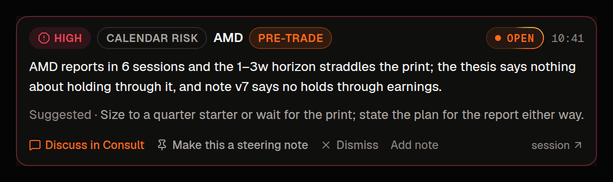
How to respond
Every finding card has these actions:
- Discuss in opens Consult with a question already written and the finding attached as a chip.
- Make this a turns the objection into a soft, symbol-scoped note for 72 hours on Strategy › Guidance, which every future session must .
- Dismiss closes it; Reopen puts it back in front of the next session; Add note keeps a note for the record. All three are audited and need an owner or operator login.
Is the Critic any good?
The Agent screen carries a Critic track record strip. Over a trailing 20-day window it compares the proposals the Critic flagged (warn or high) with the ones it left alone, on realized outcomes: a flagged trade bad if it hit its stop or ended its window with a negative return. Until 5 flagged proposals have outcomes the strip says so; after that the one-liner rides in the PM's state card, so the PM weighs the Critic by evidence rather than by default.
Failure modes you might see
- Pre-trade timeout: the 90-second pass ran out (or the Critic errored); the proposal proceeds with a note saying the Critic timed out or errored, and an alert is raised. If the process that owed the pass died, the Executor releases the proposal itself about 30 seconds later.
- Promotion failed: the pass ran but its result could not be written back (a critical "pre-trade Critic could not promote" alert). Nothing is lost: the proposals wait in
pending_criticuntil the Executor's timeout sweep releases them with a Critic-timeout note, and the session's findings are still recorded. On this build that means the optional high-severity gate cannot hold such a proposal for you; it proceeds to the Executor and its risk checks like any other. - Ignored twice: a finding the PM skipped twice is an in the .
- Expired: a finding nobody answered in 3 days closes on its own.
- Not enough outcomes: the track record strip stays blank until 5 flagged proposals have resolved.