Place a trade yourself
Operator orders are not in this build. What you can do today instead, and how your own orders will work when they land.
- Who it is for
- Owners & operators
- Reading time
- 4 min read
- Updated
- Status
- coming soon
Planned, not shipped.This page describes something that is designed but not in the console today. Nothing here is available yet unless a sentence says so.
There is no order form in Bellwether today, for anyone. You cannot type "buy 10 shares" anywhere in the console, and neither can a viewer, an operator or the owner. Operator orders are planned; this page says what exists now and what the feature will look like when it arrives.
What you can do today
Everything that moves the book still goes through the PM (shown as on ) and the , but you have several ways to act:
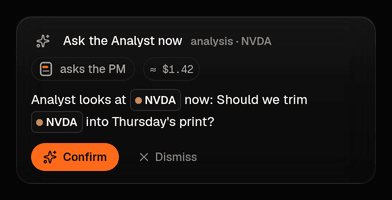
- Ask for an analysis. Open Consult and ask about a symbol or an idea; it answers from the same read-only tools the PM uses. Ask the Analyst to look now (or confirming an analysis card offers) queues an ad hoc PM run with your question at the top of its prompt, at most 6 a day, deferred to the next open when the market is closed. Any that run writes is read by the and screened by the Executor exactly like any other, and the result is posted back into the thread.
- Steer. Add a note on Strategy › Guidance: "prefer NVDA over AMD this month", "avoid airlines". The PM must every note in its next session and may disagree in writing. A note is , not an order; see playbook vs steering.
- Approve or reject. Every proposal above your waits in the Inbox. Approve sends it to the broker at a fresh quote (if the price has moved too far, nothing is sent and the PM re-proposes); Reject tells the PM why. See approve or reject.
- . The Halt button in the top bar makes the book reduce-only from any screen, without a code: no new buys, resting buy orders cancelled, sells and protective exits still allowed out.
- . In an emergency, Flatten on Risk halts the book and has the Executor, on its next 5-second loop, cancel every open order and place one marketable limit sell per position, outside the and retried with a critical alert if any step fails. It asks for an and the number of open positions, and is meant for getting out, not for trading; see the kill switch.
What you cannot do is force a buy. If the PM will not propose a name you like, the answer is a steering note or a Consult request, and then reading its reasoning on Agent to see why it declined.
Why it is this way
The safety story rests on one fact: the only thing that can send an order is the Executor, and the Executor only accepts proposals that pass its risk checks. An order form that bypassed those checks would be the one door in the house without a lock. So operator orders are not being bolted on as a shortcut; they are being built as another proposal author, with the same checks and the same audit trail.
What will land
When operator orders ship, the shape is already decided (operator decision, 2026-09-09). It is planned, not built, so details may still move:
- You place, close or reduce a position from a trade sheet in the console or by confirming a Consult card. A close or reduce you send without a limit is protected by a floor a few percent under the position's own mark (the Executor's price for it, not the quote the sheet happens to show), and the Executor works the sell at the live bid above that floor. Either way it becomes a proposal stored with you as its author, next to the PM's proposals and the Executor's own protective exits, so the lineage in the Inbox, on the Agent timeline and on Activity shows who wanted what.
- It runs through the same risk checks as a PM proposal. Long only, day in regular hours, the order cap, the position cap, , the , the daily-loss and halts: none of them know or care that a human typed the order.
- There is no approval step, because you are the approver; instead every operator order asks for a fresh authenticator code and writes an audit row. A stop and target you give are armed as the position's bracket.
- The PM adopts the position in its next session unless you mark it "manage myself", in which case the policy rejects the model's attempts to modify or close it.
Until then, the honest answer to "can I place a trade myself?" is no. The PM proposes, you decide, the Executor sends, and the Executor stays the only thing that talks to the broker when the operator gets a keyboard. See the Executor cannot be argued with.