Reports and feedback
The day report is a deterministic one-page digest of the day, profit net of AI cost included; the Report button is how you tell the operator something is off.
- Who it is for
- Everyone on the book
- Reading time
- 5 min read
- Updated
Review holds three things: one per trading day, the Advisor's plain-English suggestions about your settings, and the feedback log that the writes to. None of them changes anything on its own.
The day report
At 15:45 CT (12:45 on early-close days) the scheduler writes a one-page report on the day, one row per date. It is a deterministic read of what the PM (shown as on ), the , the , the and the scheduler already recorded. No model writes it, so it costs nothing and is reproducible. Re-running a date replaces the row; if the build fails, a warning lands on Activity › Alerts instead of a report.
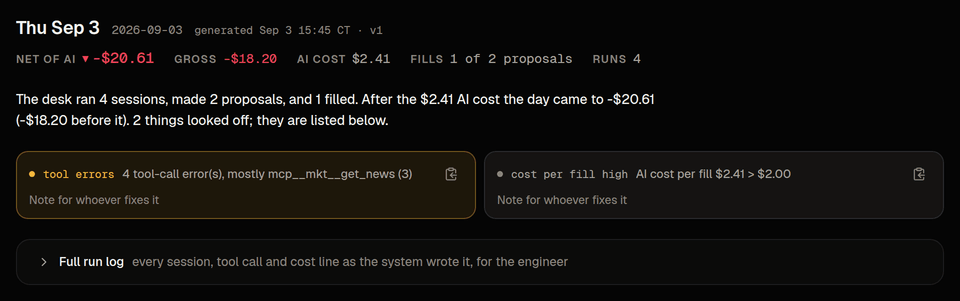
Find it under Review, on the Day reports tab: a list of days on the left (net P&L, AI cost, fills out of , runs, and an badge that turns red when any is critical) and the report on the right. The header line gives net of AI cost, gross, AI cost, fills and runs; the anomaly chips come next; then the report itself:
- Header: trading day or holiday, broker and environment, the , and in force, whether trading was and why, and the models used.
- Anomalies: anything that looked off, with a severity and a suggested tracker item. First, because it is what you act on.
- Runs: every session that ran, its model, whether it finished cleanly, turns, cost and duration; plus any scheduled run that was skipped, timed out or failed to launch, with the reason.
- Cost: spend by role for the day and the month so far, tokens, and how much of the reading was served from the prompt cache (higher is cheaper).
- Decisions: how many proposals and in which state, fills, how many expired, were deferred or are still waiting for you, how many you approved or rejected yourself, which check rejected the rest, and how far fills landed from the limit and from the quote at decision time (slippage).
- P&L: gross for the day, then net of AI cost, and the day's return. Net is the number that matters; a strategy that earns less than it spends on thinking is not a strategy.
- Critic: findings written today by severity and category, whether the PM answered, disagreed with or ignored them, and the Critic's track record against outcomes when there is one.
- Reactions and Research briefs, when there were any: event-driven sessions and what woke them; briefs and whether their calls were read.
- and Memory: notes still waiting for an ; handoffs, , and the PM wrote for itself.
- Alerts & errors: alerts by severity and kind, tool-call errors, denied tools, halts, sign-in lockouts, and the sessions that ended in error.
Anomalies, in plain terms
- Critical: a halt today, a steering note still unacknowledged after sessions ran, or a session whose output could not be read. Look the same day.
- Warning: a timed-out or errored session, a scheduled run that was skipped or failed to launch, a successful session that left no handoff, a Critic finding ignored by two or more sessions, three or more rejections on the same check, three or more tool-call errors, p95 slippage above 25 bps, cache hit rate under 50%, AI spend at 80% or more of the daily budget, sign-in lockouts, or the end-of-day book not written.
- Info: expired proposals, a trading day with no proposals at all, AI cost above $2 per fill, or spend without any fills. Worth knowing; rarely urgent.
Each anomaly is a chip at the top of the report with its id, a one-line summary and the suggested tracker item, plus a copy button so it can be pasted straight into the tracker.
The Advisor tab
The Advisor tab on Review lists a second deterministic digest per day: suggestions about your settings computed from the last 10 trading days (a limit pinned tighter than the default that keeps blocking proposals, for example), each with its evidence and a link to the screen that owns the setting, prefilled. It never applies anything; you decide on the owning screen.
The Report button
The small flag in the top bar opens a short form; on a phone the same flag sits in the More sheet (More › Report), and ⌘K can open it too. Pick a kind (Bug, Confusing, Wrong call, Idea or Other), write a sentence or two (up to 4,000 characters), choose a severity of Low, Med or High, and send. The screen you were on is attached automatically: the route, the selected session, proposal, symbol or day report, the if you were on one, and your viewport. The toast says "Logged, thanks".
Notenothing you write here reaches the PM. Reports go to a feedback log that the operator triages the next morning.
Owners, operators and reviewers can send reports, and so can someone viewing your book through a read-only share (their row is tagged with the book they were viewing). A plain viewer account is read-only and cannot. Every help article also ends with Was this article helpful?; those thumbs land in the same log.
The feedback log
Review › Feedback shows everything sent from this book, newest first: who logged it and their role (), the kind, the severity, the time, the route they were on with the session, proposal, symbol, report or algorithm as clickable chips, and a status of new, triaged or done. Filter by status, or press From others to see only rows logged by other accounts. A badge on the tab counts new items.
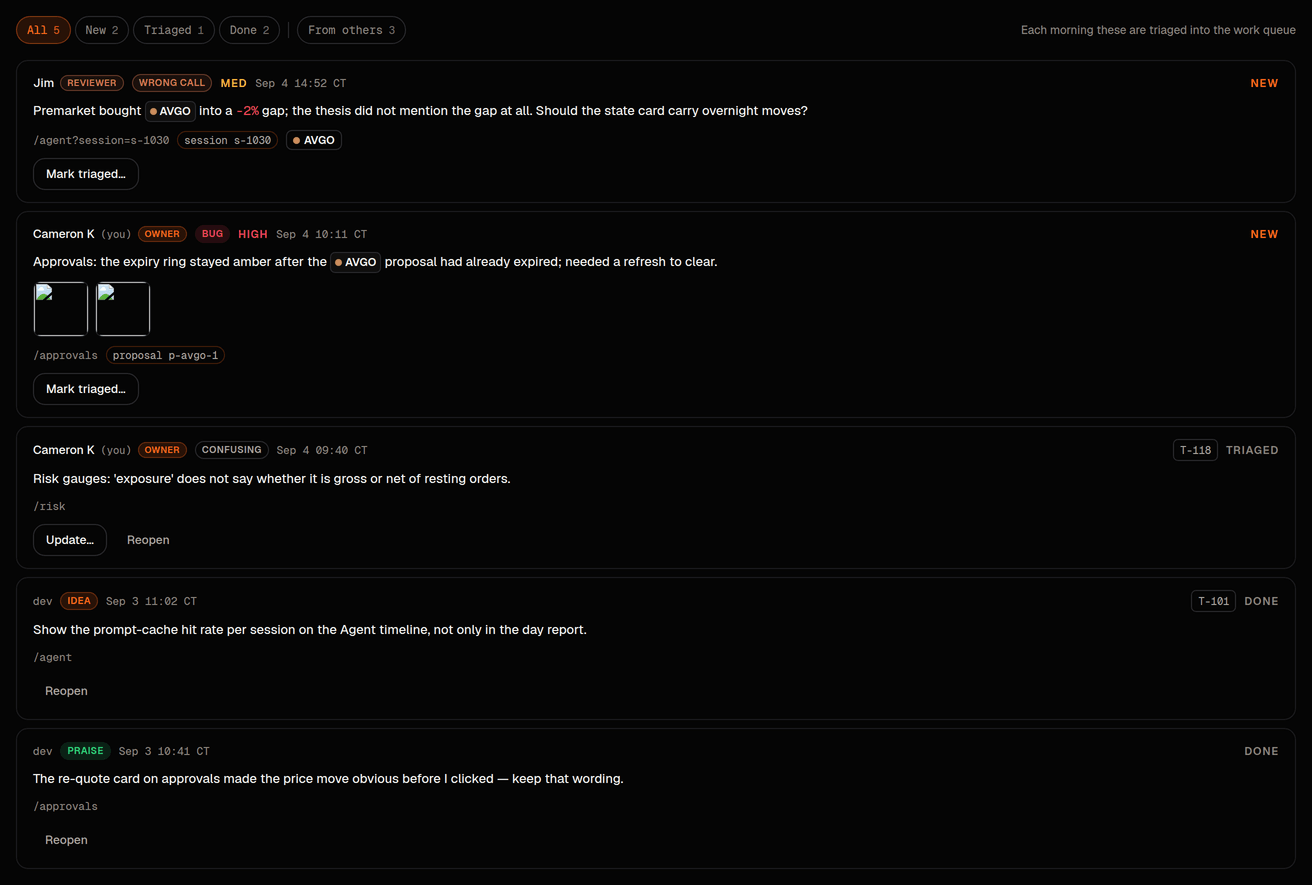
Owners and operators triage from here: Mark triaged… records the tracker reference it became, Done closes it, and Reopen sends either back to new. Each change is audited. Reviewers, viewers and visitors see the log but cannot triage.
How feedback reaches the operator, not the agent
There is no path from a feedback row to a steering note, a lesson, a prompt or a memory file. The operator reads the log (the same rows print as proposed tracker items next to yesterday's anomalies and the Advisor digest), decides what to do with each (build it, change a rule or prompt, test it in the Lab first, or park it), and only then does anything enter the tracker, with the row linked as provenance. A reviewer's "wrong call" is discussed, never ingested. If you want the PM to behave differently today, that is what a steering note on Strategy › Guidance is for, and only an owner or operator can write there.