What's the point of Bellwether?
Why a staffed desk that reads, argues, sizes, explains and reviews itself is a different thing from a buy button, and what it honestly does not do.
- Who it is for
- New to Bellwether
- Reading time
- 4 min read
- Updated
A fair question from anyone with a brokerage app: it has a buy button, charts and news, and it is free. Why run anything else?
Because the button is not the hard part. The work around it is: reading everything before the open, writing down why you own a thing and what would prove you wrong, sizing it so one idea cannot hurt you, watching it during the day, and looking back honestly at what you got right. A brokerage gives you the button; Bellwether gives you a staffed desk that does that work on rules you set, and shows you all of it.
Someone reads everything before the open
At 07:45 CT the works through the overnight tape, filings, earnings dates and macro releases and writes a short brief about your book: what moved, why it matters for what you hold, what it is watching, and a few ideas marked plainly as ideas, not orders. Every source is a link its own tools returned in that session, and its checkable calls are scored later against daily closes by arithmetic, not by a model. Brief, sources and hit rate are on Research.
Someone watches your names against levels it wrote down
The PM (shown as on ) opens the day at 08:00 with the brief in hand, then checks in through the session. Every position it proposes carries a , an ("wrong if below") and a horizon, written before the trade, so a check-in compares prices with its own words rather than a mood. A fill, a stop coming close or a watched level crossing earns a short session on that name alone. The card labelled Agent on the Overview says what it is doing now (reading the analyst card); each session's reasoning, tool calls and are on Agent. Tell it what you think on Strategy › Guidance and the next session must answer.
Every idea is sized and stopped by rules you set
No model can place an order. The is plain, tested code with no model inside, and it runs every proposal through the same , among them order and position size, , a fresh quote, an , and your and lines. The numbers are yours, on Risk › Limits; they move only within bounds written into the code, and loosening one asks for your . Which checks a proposal passed is on Agent › proposal checks. Neither the PM nor you can talk the Executor out of any of it: the Executor cannot be argued with.
Every decision comes with its reasons
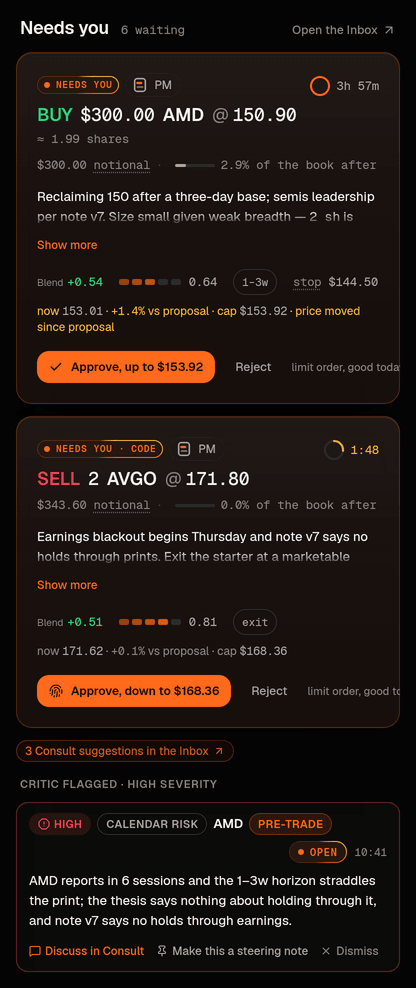
A card in the Inbox is a ticket, not a tip: the thesis in the PM's words, its confidence, horizon and invalidation level, the live price against the proposed one, and the policy notes the Executor attached. Behind it, the session on Agent shows the tool results the thesis rests on, and a objection sits beside the proposal with the evidence it used. You are never asked to trust a conclusion you cannot read.
The desk reviews itself and keeps score
After every session that proposed something, the Critic, a separate model with a fresh context and no stake in the idea, reads the same data and writes down what looks weaker than claimed. The PM must answer each finding at its next session; unanswered ones are counted, not dropped. At 15:15 the PM writes a journal and reviews every open thesis; at 15:45 a deterministic sums up the day, AI cost included. What became of each proposal opens the next session's , so the desk learns from its own record. The Critic track record strip on Agent's Sessions tab shows how often its objections were right over 20 days, and Performance is the book's own record: returns against benchmarks, drawdowns, and a trade journal naming the each trade cited.
Nothing happens that you did not authorize
The on Strategy › Profile › Autonomy is one number, the approval threshold· Strategy › Profile › Autonomy: a new book starts on Manual, where every order waits for your yes in the Inbox, and raising it is an audited step that asks for your code (autonomy levels). The Halt· Halt (top bar) · Risk header button in the top bar stops all new orders from any screen. Every change (a limit, an approval, a , a sign-in) is on Activity with who, what and when.
NoteNone of this is a claim about returns. A desk that reads, sizes, explains and reviews itself can still be wrong about a stock. What it cannot do is be wrong quietly, or bigger than you allowed.
What it does not do
- It does not promise returns. It shows its record on Performance and lets you judge.
- It runs on paper money until you deliberately . Real prices, pretend money; going live is a sequence outside the console, not a click: paper vs live.
- It never moves money in or out. No code deposits, withdraws or links a bank; you fund at your broker.
- It stops when you say so. One tap on Halt, from any screen, no code asked: the kill switch.
- It is not free to run. Every session is model usage drawn from a daily budget, and the console shows what was spent; Model policy has the caps.
- It does not decide for you. Ask Consult about your book, steer the PM in plain English, reject a card with a reason: the desk works for you, not instead of you.
Next: Meet your desk for who does what, or Your first day to get set up.