Pins and the feed
The research feed and its filters, pinning an item so the next brief has to answer it, standing if-then watches that wake the PM when an event lands, muting symbols and sources, the calendar, and what a symbol chip can do.
- Who it is for
- Owners & operators
- Reading time
- 7 min read
- Updated
Research is one corpus shared by you and the agents. Everything in the feed is exactly what the , the PM (shown as on ), and the can read through their research tools, and every read is recorded, so a card can say "read by Analyst 09:31" or "cited in 07:45 brief". Pinning or muting never changes what is ingested or how it ranks; it changes what the next brief must answer and what stays visible.
The feed
A research worker pulls into one list, every 10 minutes while the market is open and hourly outside it: headlines for held names, the and the index ETFs; filings on held names (once a filings source is configured); earnings dates within 10 days; the macro calendar (CPI, FOMC, NFP, PCE, GDP); movers of 2% or more at 09:00, 12:00 and 15:15 CT; and a regime note whenever the label changes. Items keep a title, a sanitized summary of at most 600 characters and a link (never an article body), and are pruned after 30 days.
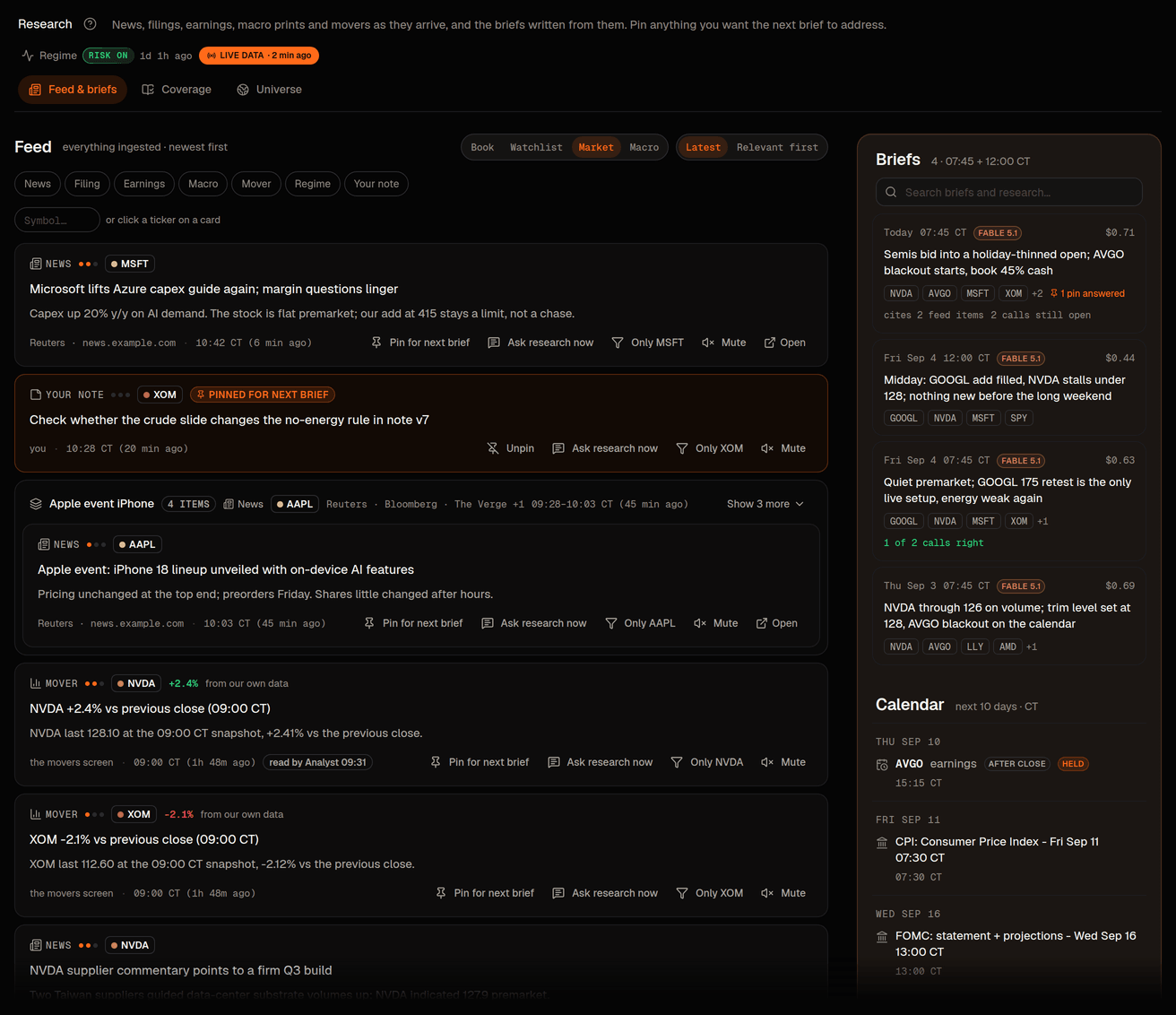
Two filters sit above the list: scope, which is Book (names you hold), Watchlist (your effective allowlist), Market (everything, the default) or Macro (scheduled releases plus regime); and multi-select kind pills: News, Filing, Earnings, Macro, Mover, Regime and Your note (a leftover on this build: your own notes are no longer feed items, so that pill matches nothing; they live in the Pins panel). Each card shows its kind, importance dots (held +2, watchlist +1, a material 8-K or earnings within 5 days +1), symbol chips, the title and summary as plain text, and the source and time. New arrivals do not reshuffle the list; a "N new" button appears at the top to show them. The strip under the heading shows the current regime and a Live data or Data stale chip.
Pin an item for the next brief
Pin for next brief on any card opens a note field (what you want answered, up to 600 characters). The card turns ember with a "pinned for next brief" badge, and the pin appears in the Pins panel as open with a "lapses in" countdown.
The note stays on your book's pin; it is never copied into the shared feed. What the Researcher must do with it: the next brief's prompt for your book quotes your pin and its note as data, not as an instruction to trade, and the brief has to address every pin explicitly: a sentence in the prose and a written response. The brief view then shows an "Operator pins addressed" block ("you asked · the brief answered"), the pin flips to addressed with a link to that brief, and the brief row counts "1 pin answered". If a brief skips a pin, the brief still lands but a warning alert and an audit finding are written against it. A pin two briefs pass without answering is marked expired ("expired unanswered"). Unpin on the card, or the X in the panel, removes a pin at any time.
Mute a symbol or a source
The Mute menu on a card offers "Mute NVDA" for each symbol on it and "Mute source · publisher". A mute hides matching items from your feed and from the agents' research tools for this book only. Muted chips sit at the bottom of the Pins panel; click one to unmute. Nothing is deleted.
The calendar
The Calendar panel covers the next 10 days in Central time: earnings on held or watched names with "before open" or "after close" tags and a "held" badge, macro releases with their time, half days and market holidays. It is the same calendar the Researcher reads for calendar risk.
Standing if-then watches
A pin says "answer this in the next brief". A standing if-then watch says "if this event shows up in the feed in the next few months, wake the PM and have it reconsider that". They live in the Standing watches panel on Research, with Open, Hit, Expired and Dismissed tabs.
Add one with the panel's Add button, or from any ticker chip's Add if-then watch…, which opens the same form with the symbol filled in. You write the condition as a headline would state it ("FDA delays the VMware approval decision", up to 200 characters), the then-action ("revisit the AVGO short; size 1%"), optionally the names a headline would carry and the kind of event (earnings, , M&A, macro print, FDA, rating change, legal, product, IPO, or auto), the symbols, and how many days until it lapses (90 by default, 180 at most). The Researcher writes them too, from a brief's Ideas, and a PM session can leave up to four in its handoff; each row says who wrote it. A condition with nothing matchable in it is refused rather than stored to never fire.
What fires it is code, not a model. After every ingest cycle the research worker compares the new feed items with every open watch in your book: a shared symbol or a distinctive named entity together with the same kind of event, or enough shared terms, a match; where the deployment has an embedding key, a semantic similarity above the threshold with the same event kind also counts (the panel says "semantic matching off" when there is no key, and matching then runs on terms alone). A match marks the watch hit · PM checking, records why it matched (the terms, the scorer, the score; never the headline's text), and writes one wake event for your book. Nothing in another book can match into yours.
What the PM does when woken. The wake and the both say "a candidate, not a fact". The react session (or, if react budgets defer it, the next scheduled session, which sees the hit in its "Since your last session" list) reads the matched item with its research tool, checks the condition and any numeric guard against live data, and answers one of two ways: confirm, where the badge turns to hit · confirmed and, if the then-action still makes sense, the PM acts the only way it can, through a under the ; or not yet, which clears the hit, re-opens the watch, records the non-match, and keeps that watch out of the matcher for 6 hours so one story is one wake rather than one per headline. A PM that notices the event on its own can mark an open watch hit itself; the row then reads hit · PM found. On this build react wakes are dispatched for the house book only; other books' PMs pick the hit up at their next scheduled session.
Where it shows. The row carries the if / then text, symbol chips, the event kind, the guard, "not yet ×N" for candidates the PM turned down, who wrote it and when, and "lapses in Nd"; a hit links to the matched feed item and, when a brief wrote the watch, to that brief. Activity lists each wake as an event with the scorer and terms matched. Dismiss a watch with the X and an optional note; expired ones say "expired unmet", and the PM's state card notes how many lapsed since the last brief. The keeps a 7-day precision line per scorer (confirmed versus not yet) so a noisy matcher is visible.
Ask, steer, filter from a symbol chip
Every ticker in the feed and in a brief is the same chip. Click it for the last price and day change when the console has them, then: Open detail (the symbol drawer), Ask the analyst (opens Consult with "What is your current read on NVDA?" filled in), Steer… (opens Strategy › Guidance for that symbol), Filter activity (opens Activity on that symbol) and Add if-then watch… (the standing watch form with the symbol filled in). Rows in the Briefs panel are one button each, so their chips are plain; open the brief to use them.
Ask research now on a card opens the Consult drawer with the headline already phrased as a question about your book. Consult answers from the same read-only tools; it cannot trade or change anything on its own.
What is shared and what is yours
The feed items themselves (news, filings, earnings dates, macro releases, movers, regime notes) are public market data, the same for everyone on the deployment. Pins, the notes you write on them, mutes and briefs belong to your book only, and nothing you type is ever written into the feed; see the isolation promise.